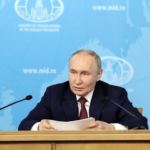




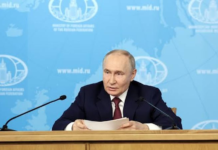




Russian President Vladimir Putin warned that the world is entering an “extremely unstable and ever changing” period marked by the erosion of international law, institutional crises and growing geopolitical tensions, while calling for the emergence of a more stable multipolar global order.
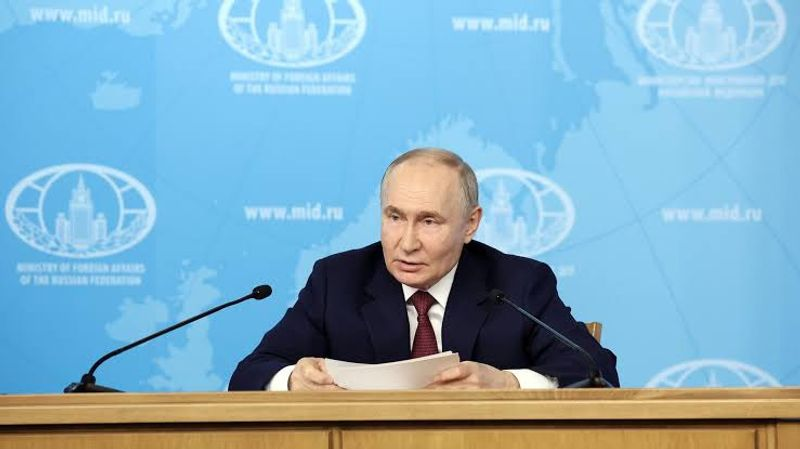
Addressing the plenary session of the 23rd annual meeting of the Valdai Discussion Club, Putin said the world had reached a “decisive turning point” as rapid changes in technology, artificial intelligence, climate, medicine, military science, demographics and the global economy were reshaping societies and international relations.
“The world has reached a decisive turning point in its development,” Putin said, adding that humanity was entering “a completely new and unprecedented reality” where threats and opportunities were increasingly intertwined.
He said the scale of ongoing transformations was immense and warned that technological progress was creating both opportunities to improve human life and new risks capable of threatening humanity.
“Technology is opening up, quite literally, fantastic prospects for extending lifespans and improving the quality of life. However, it is also taking the possibilities for the destruction of all humanity to a whole new level,” he said.
Putin said the profound changes were also contributing to political tensions within countries, as traditional political systems struggled to adapt to changing societies and growing uncertainty.
“One consequence includes domestic political ‘fever’ in many countries, all the more so because traditional party systems are increasingly failing to reflect rapidly changing social structures,” he said.
He warned that governments could respond to internal instability by taking actions beyond their borders, thereby aggravating international tensions.
“In other words, they may, unfortunately, export instability which only exacerbates and heightens tensions,” Putin said.
The Russian president predicted that international conflicts were likely to continue as major geopolitical and economic shifts encouraged countries to take greater risks in pursuit of strategic advantages.
“I wish I were wrong in this assessment, but the sustainable trends we are witnessing, unfortunately, suggest otherwise,” he said.
At the same time, Putin expressed confidence that the world would eventually move away from what he described as Western hegemony towards a multipolar international system.
“We remain confident that, in the long term, as the world moves away from Western hegemony, the international situation will gradually improve leading to a more stable, democratic, and free multipolar international order,” he said.
Putin said the transition would nevertheless involve considerable risks and that the immediate priority for policymakers should be to minimise those risks.
Putin said the mechanisms created in earlier decades to regulate relations between states were no longer fully effective because the international environment had fundamentally changed.
“The mechanisms for striking a balance between state interests and actions as they evolved over the preceding years are unable to fully and effectively fulfil their regulating function,” he said.
He criticised some international organisations for failing to reduce risks and, in some cases, contributing to them by serving the interests of particular countries or groups.
Putin also targeted the United Nations, saying criticism of the organisation was not always objective but arguing that there were “well-grounded objections” concerning its functioning.
According to Putin, a “narrow grouping of Western countries wields an unproportionally large influence” within the UN despite representing a minority of the global population.
He said Russia supported reform of the United Nations to better reflect the changing balance of power, with greater roles for countries from Asia, Africa, Latin America and the Middle East.
“Russia still continues to support the idea of fair reform of the United Nations,” he said, adding that such reform would require internal consensus.
Putin said UN reform should go beyond expanding the Security Council or achieving geographical representation and should also involve reconsidering the organisation’s priorities in light of emerging global challenges.
Putin devoted significant attention to artificial intelligence and the wider impact of technological change, saying AI was creating questions that did not exist when many international institutions were established.
He said countries needed to examine not only the economic and technological consequences of AI but also its social, cultural and humanitarian implications.
Putin warned against uncontrolled integration of AI into areas affecting human moral and cultural development.
“Such digital totalitarianism would be just as much of a dead end, and just as bleak and inhumane, as the totalitarian societies of the past,” he said.
He also raised questions over how increasingly digitalised states could preserve their sovereignty and security without isolating themselves from technological progress.
Putin said advances in biotechnology and genetic engineering raised similarly profound questions, including the possibility of altering the human body, shaping personalities and influencing behaviour and thought.
“It is essential to combine the efforts of countries and communities to work together on mutually acceptable solutions to these extremely delicate, defining, truly existential questions,” he said.
Putin said new international groupings were emerging as the existing global order undergoes transformation, pointing to regional associations as well as global structures such as BRICS.
He said such organisations had “great prospects” but still needed to establish their functions and determine the limits of their capabilities.
He cautioned against expecting relatively new organisations to rapidly rebuild the global system.
“This is a long and thorny path with many unknowns, but it will undoubtedly lead to results,” he said.
Putin rejected the idea that the current crisis of international institutions necessarily meant the world was destined for chaos.
“Does this mean that we are now doomed to chaos No, it is certainly premature to make such a judgement,” he said.
He argued that major powers carried a particularly heavy responsibility because their decisions could either reduce global risks or deepen existing tensions.
Turning to the Ukraine conflict, Putin reiterated Russia’s longstanding justification for its military action and rejected the argument that Moscow had initiated the confrontation.
“It is a fact that many hundreds or even thousands of experts… might ask why Russia started the war while talking about peace,” he said.
“Where is the truth The truth is that we did not want and were not the ones who started to fight. In fact, they started to fight against us,” Putin said.
He blamed what he described as “aggressive nationalism and Russophobia in Ukraine” and accused NATO of seeking to incorporate what he called Russia’s “historical territories” into its military space.
Putin also alleged that Western countries had supported political changes in Kyiv and supplied offensive weapons to Ukraine.
He said Russia had ultimately been “forced to defend itself with arms in hand”, describing the conflict as the result of deliberate efforts to place Moscow under pressure.
“I am convinced that this was an intentional effort to place Russia in a situation when it was simply forced to defend itself with arms in hand to respond to this obvious act of aggression,” he said.
Putin said Moscow remained interested in peace and cooperation but acknowledged that rebuilding trust between competing states would be difficult.
“Confidence building is a painstaking and fragile process. Placing it on the right track is very hard, while it can be derailed very easily,” he said.
Putin said the international system would eventually settle into a new equilibrium through compromises and a willingness among countries to accommodate one another’s interests.
“The former hegemon will unavoidably have to acknowledge the realities of a multipolar world,” he said, arguing that Western countries would have to learn to cooperate with the Global Majority while respecting their fundamental interests.
He warned, however, that the transition would be unpredictable.
“We are going to have to live in an extremely unstable and ever changing world,” Putin said. “The path to a new system will be full of unexpected twists and turns; unfortunately, often unpleasant and even dangerous ones.”
He also criticised what he described as the growing reliance on the principle that “might makes right” in international affairs, saying attempts by countries to secure unilateral advantages could worsen instability.
“Moral and ethical constraints and basic standards of decency still matter,” he said, warning that deception, broken commitments and the distortion of facts could undermine the foundations of international coexistence.
In a separate part of his speech, Putin reflected on the collapse of the Soviet union 35 years ago, describing it as a profound transformation that affected tens of millions of people.
He said the Soviet collapse resulted primarily from internal problems rather than external factors.
“The Soviet union collapsed due to a mix of internal imbalances. This is the most important dimension to it. This is the truth, and this is what happened,” Putin said.
He attributed the collapse to what he described as “mistakes made by successive generations of the country’s leadership”, including short-sightedness, ideological dogmas, incompetence and failure to address obvious problems.
Putin also criticised the Soviet leadership’s reliance on Western goodwill and what he called “gentlemen’s agreements”.
“Blind trust in Western partners and confidence in ‘gentlemen’s agreements’… also played a cruel joke on the Soviet Union,” he said.
He argued that Soviet leaders wanted Western approval while Western governments sought to reshape the post-Soviet order in accordance with their own interests.
Putin argued that the current period of global transformation required countries to look beyond immediate political and administrative concerns and focus on the long-term consequences of their decisions.
“Responsibility for our shared future is far more than just an abstract slogan,” he said, calling for practical measures to prevent humanity from being pushed towards catastrophic scenarios.