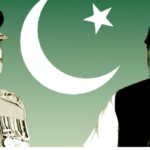













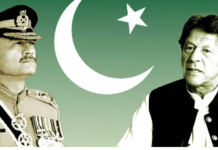











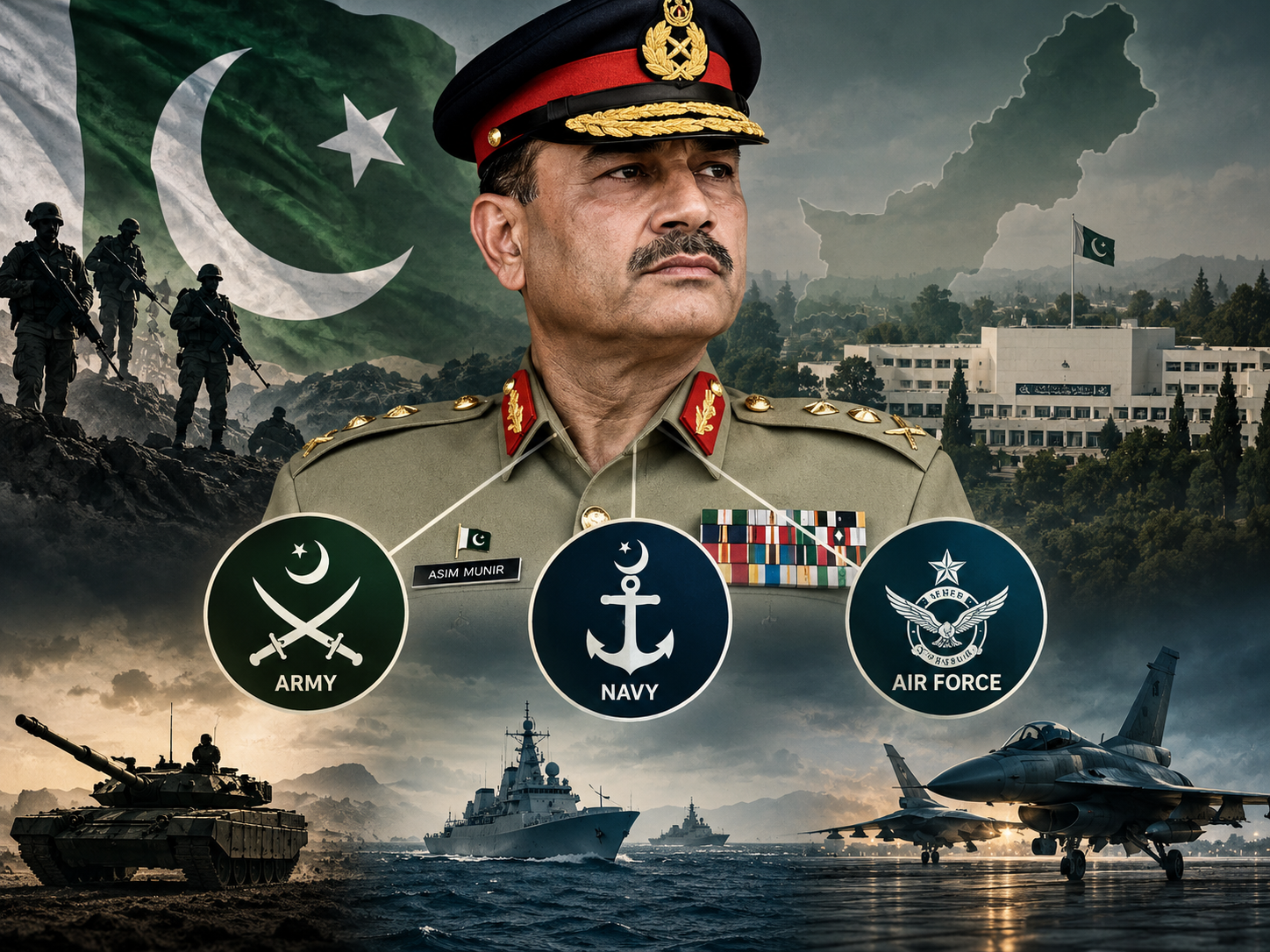
Pakistan’s civil-military balance is undergoing one of its most consequential transformations in decades. Under Field Marshal Asim Munir, the military’s role is no longer limited to defence and security. Recent constitutional and legislative changes have formally strengthened the position of the army chief within Pakistan’s wider command structure, raising renewed questions about the boundaries between civilian authority and military power.
The central development is the creation of the Chief of Defence Forces (CDF) position, held concurrently by the army chief. Legislation passed in August 2026 gives the CDF operational command and control over Pakistan’s armed forces, replacing the previous arrangement in which the chairman of the Joint Chiefs of Staff Committee primarily served as a coordinating figure.
For Pakistan’s political system, this is more than a technical military restructuring.
It changes where institutional power is concentrated.
From Army Chief to All-Armed-Forces Commander
The new structure places the army chief at the centre of the command architecture covering the army, navy and air force.
The Defence Forces of Pakistan Act, 2026, and amendments to the National Command Authority Act gave legal effect to the new command structure. The Defence Forces Headquarters is headed by the CDF, currently Munir.
That represents a significant departure from the previous system.
The old chairman of the Joint Chiefs of Staff Committee was primarily a coordinator and did not exercise operational command over the other services. Under the new framework, the CDF has operational command and control across the armed forces.
In practical terms, the office traditionally associated with Pakistan’s most powerful military institution has acquired an even broader formal mandate.
Civilian Oversight Under Pressure
The most contentious question is not whether Pakistan needs an integrated military command.
It is whether the expansion of military authority changes the balance between elected civilian institutions and the armed forces.
Pakistan’s Constitution states that the federal government has control and command of the armed forces. Critics of the new arrangement have argued that giving the CDF operational command raises questions about how that constitutional principle works in practice. Others, including constitutional lawyers cited by Al Jazeera, argue that Parliament has simply legislated the command structure created by the constitutional amendment.
The disagreement itself is significant.
A system cannot claim a clear civil-military equilibrium when the precise boundaries of civilian and military authority are the subject of such intense institutional debate.
The Munir Factor
The concentration of offices in one military leader makes the restructuring particularly consequential.
Munir is simultaneously army chief and Chief of Defence Forces. He was promoted to the five-star rank of field marshal in May 2025, and the constitutional changes extended his tenure as CDF to at least 2030.
The 27th Constitutional Amendment also created a new National Strategic Command structure involving the country’s strategic and nuclear command architecture. Reporting has noted that the reforms significantly altered the distribution of power within Pakistan’s military establishment.
Whatever the government’s justification, the institutional effect is unmistakable: more authority is being concentrated at the top of the military hierarchy.
Military Power Is Also Visible Beyond the Barracks
Munir’s expanding role is not confined to military command.
In August, he travelled to Tehran for talks with Iran’s leadership as part of Pakistan’s effort to mediate in the US-Iran conflict. He met senior political and security officials, including Iran’s president and parliament speaker. Analysts cited by Al Jazeera described his role as providing a military-to-military channel into Iran’s security establishment.
Pakistan has also placed its military leadership prominently in the country’s expanding defence relationships with Saudi Arabia and Türkiye. Munir participated in the first meeting of the Strategic Political and Defence Committee established under the Makkah defence agreement.
These developments illustrate how Pakistan’s military leadership is increasingly visible not only in defence policy but also in regional diplomacy, strategic negotiations and international security partnerships.
A Long-Standing Pattern, Now More Formal
Pakistan’s military has exercised enormous political influence throughout the country’s history. Al Jazeera notes that the army has staged four coups and ruled Pakistan directly for more than three decades since independence.
What distinguishes the current moment is the degree to which elements of that influence are being formalised through constitutional and legislative mechanisms.
That matters because informal influence can be challenged politically. Formal authority becomes embedded in institutions, laws and chains of command.
The transformation therefore goes beyond the personality of one army chief.
It concerns the architecture of the Pakistani state itself.
The Civilian Question Pakistan Cannot Avoid
Pakistan’s government can argue that the new structure improves military coordination, strengthens strategic decision-making and reflects lessons from recent conflicts.
Those are the stated institutional arguments.
But the larger political question remains: how much power should Pakistan’s military command exercise over national affairs, and what mechanisms ensure effective civilian oversight?
That question becomes more important as the military’s role expands across defence, strategic policy and regional diplomacy.
A stable civil-military system requires clearly defined authority and meaningful institutional checks. If those boundaries become increasingly blurred, political power risks becoming concentrated in institutions that are not directly accountable to voters.
A New Chapter in Pakistan’s Power Structure
The debate surrounding Asim Munir is therefore not simply about one general.
It is about a structural transformation in Pakistan’s civil-military equation.
The creation of the CDF, the concentration of the position in the serving army chief, the expanded operational command over all three services and Munir’s increasingly prominent role in strategic diplomacy have together created a markedly different power architecture.
The central issue facing Pakistan is no longer merely who commands the military.
It is how Pakistan defines the boundary between military authority and civilian government.
And that boundary is becoming one of the country’s most consequential political questions.