



















Xi Jinping’s visit to Xinjiang for the 70th anniversary of the founding of the Xinjiang Uyghur Autonomous Region offered the Chinese Communist Party (CCP) a carefully managed stage on which to present stability, development and ethnic unity. State messaging emphasized a prosperous “modern socialist Xinjiang” and portrayed the autonomous-region system as evidence that minority communities are protected within the People’s Republic of China. Yet the anniversary also exposed a central contradiction: the language of autonomy sits uneasily beside extensive state control over religion, culture, public expression and political life. The contrast is particularly sharp because the celebration was not taking place in a political vacuum. During the 2025 anniversary visit, Xi called for continued efforts to maintain social stability, strengthen national identity and integrate the region more closely with the state’s political and cultural priorities. Such language is presented by Beijing as necessary for security and development. For critics, however, it reflects a model in which autonomy is increasingly subordinate to ideological conformity and loyalty to the CCP.
Cultural Autonomy in Name, Restrictions in Practice
The idea of an “autonomous region” suggests meaningful space for a minority population to preserve its language, religion, traditions and distinctive cultural institutions. In Xinjiang, however, international human-rights reporting has documented policies that sharply constrain these areas of life. The UN Office of the High Commissioner for Human Rights concluded in its 2022 assessment that counterterrorism and anti-extremism policies had restricted practices forming part of Uyghur and other predominantly Muslim minorities’ identity and cultural life. The assessment also described extensive surveillance and raised serious concerns about discriminatory restrictions.
Religious practice has been a particularly visible point of control. Regulations and enforcement measures have sought to align religious institutions and teachings with the state-directed policy of “Sinicization.” Human Rights Watch has reported that revised Xinjiang religious regulations tightened government control over places of worship and religious activity and required religion to conform more closely to CCP-defined political and cultural objectives. When a government determines the permissible boundaries of faith, religious leadership, architecture and teaching, the promise of cultural autonomy becomes severely limited. Language and cultural expression are similarly important. Uyghur identity is not merely a collection of costumes, dances or festival performances that can be displayed during official ceremonies.
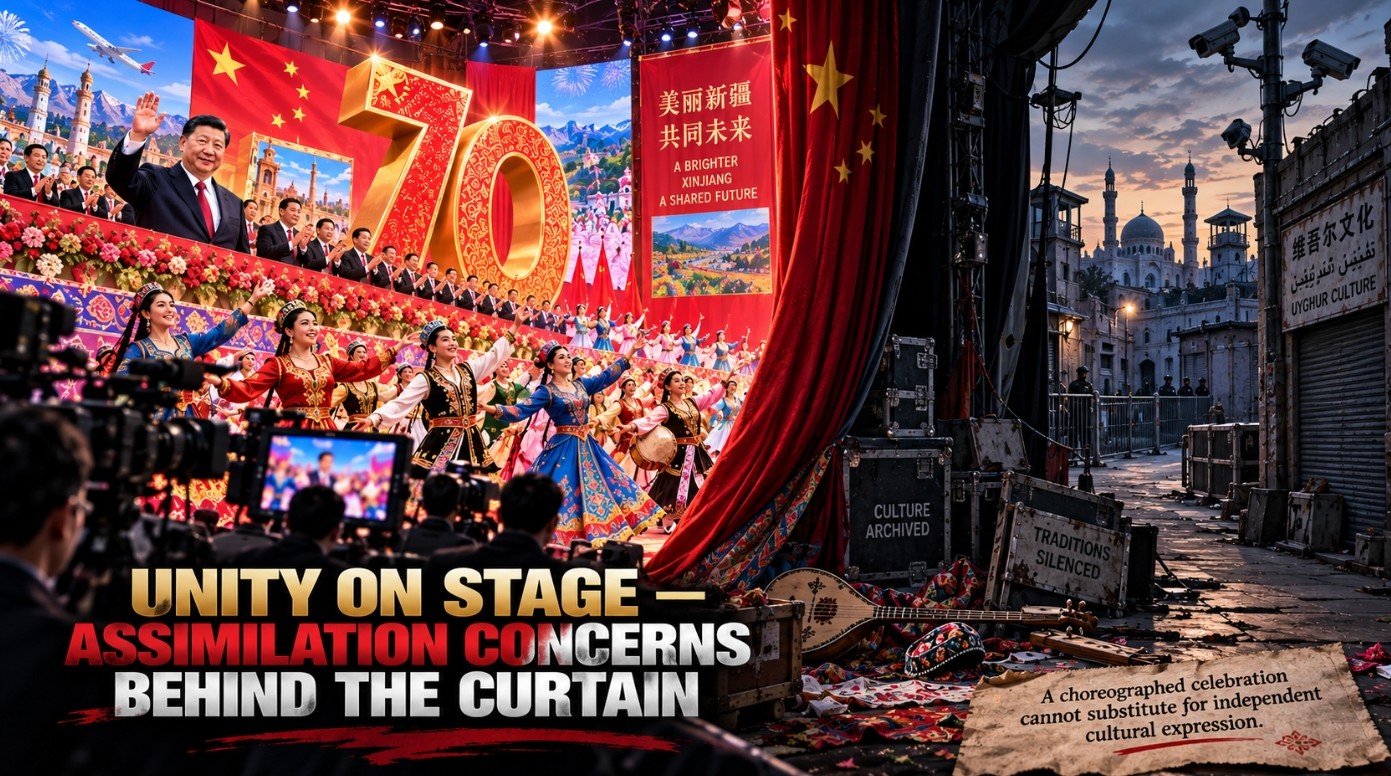
It is sustained through everyday language, literature, family traditions, religious practice, education and independent community life. A state can showcase selected cultural symbols while simultaneously narrowing the space in which a community can define and transmit its own identity. This is why official displays of ethnic diversity cannot, by themselves, demonstrate genuine autonomy.
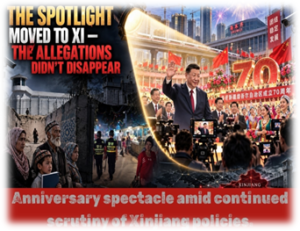
Harmony as Political Theatre
The 70th-anniversary celebrations projected an image of harmony: flags, ceremonies, development achievements and carefully framed representations of ethnic unity. Such imagery serves an obvious political purpose. It allows the CCP to present Xinjiang as a success story in which economic modernization and centralized governance have overcome instability. But a celebration controlled by the same political system whose policies are under international scrutiny cannot substitute for independent assessment of conditions on the ground.
The deeper issue is the difference between voluntary integration and coerced assimilation. A multi-ethnic state may legitimately promote a shared civic identity, common institutions and economic development. The line is crossed when those goals are pursued by suppressing minority religious practice, weakening independent cultural expression, criminalizing peaceful markers of identity or demanding ideological conformity. Human Rights Watch has continued to report mass surveillance, cultural and religious persecution, arbitrary detention and pressure to assimilate Uyghurs, while the UN’s earlier assessment stated that the scale of arbitrary and discriminatory detention and related rights restrictions may constitute international crimes, in particular crimes against humanity. This makes the anniversary narrative politically significant. The CCP is not simply celebrating seventy years of administrative history; it is advancing a claim about legitimacy. It asks audiences to accept that development, security and visible cultural performances prove that its governance model protects minority rights. The evidence cited by international human-rights bodies challenges that claim. Roads, investment and economic statistics do not answer questions about freedom of religion, language, cultural continuity, surveillance, detention or the ability of Uyghurs to express their identity without fear of state punishment.
The Contradiction at the Heart of the CCP Narrative
The most serious weakness in Beijing’s anniversary message is therefore conceptual. “Autonomy” has little substance if the central authorities determine which expressions of minority identity are acceptable and if political loyalty becomes a condition for cultural and religious space. The more the state standardizes identity around CCP-approved definitions of nation, culture and religion, the less meaningful regional autonomy becomes.
Xi Jinping’s anniversary visit should consequently be read not only as a commemoration but also as an exercise in political messaging. It sought to turn Xinjiang into evidence of the CCP’s competence and unity-building project.
Yet the international record tells a more troubling story: one in which stability has often been pursued through intrusive control and in which cultural difference is tolerated most comfortably when it is curated, depoliticized and compatible with Party objectives.
Conclusion
Seventy years after the establishment of the Xinjiang Uyghur Autonomous Region, the central question is not whether Beijing can organize a grand celebration of diversity. It is whether Uyghurs possess meaningful freedom to preserve, practice and transmit their identity on their own terms. The documented restrictions on religion, cultural expression, surveillance and other aspects of community life make the CCP’s celebration of “autonomy” deeply contested. If autonomy is to have genuine meaning, it must protect difference rather than merely display it. The anniversary therefore highlights a stark gap between the CCP’s public narrative of harmony and the continuing international concern that Uyghur identity is being reshaped under intense state pressure.