













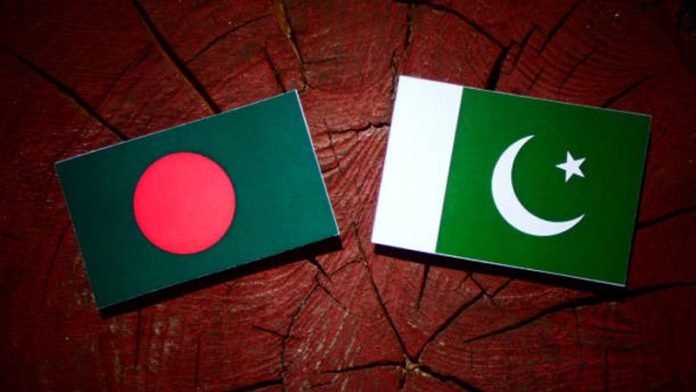
Bangladesh on Sunday raised pending issues, including an apology for the 1971 war, with Pakistan’s Foreign Minister Ishaq Dar, who is the most senior leader from his country to visit Dhaka since 2012.
Dar, who arrived in Dhaka on Saturday on a two-day visit aimed at rebuilding ties with Bangladesh following the ouster of longtime prime minister Sheikh Hasina, held talks with the interim government’s Foreign Adviser M Touhid Hossain.
“We have raised unresolved issues such as an apology or expression of regret for 1971, claims over assets, and the matter of stranded Pakistani citizens (with Dar),” Hossain told reporters after talks with Dar.
It would be wrong to expect problems of 54 years to be solved in a single day, he said.
“Both countries have presented their respective positions on these issues,” the foreign adviser said at a press conference.
Dar, who is also the deputy prime minister, said the unsettled issues over 1971 were resolved twice — first in 1974 in tri-partite talks involving New Delhi in India.”Later, the then president Pervez Musharraf settled the issues of genocide again during his Dhaka visit when he talked in public with an open mind,” Dar added.
One agreement and five memorandums of understanding (MoUs) were signed between the two countries, the Bangladeshi foreign adviser said.
Hossain said both countries have agreed that to move bilateral relations forward, historical issues must be resolved through discussion.
This is not the first time that Dhaka has raised the pending 1971 issues with Pakistan. In April, in the first foreign secretary-level talks in 15 years, Bangladesh had asked Pakistan to resolve unsettled historical issues and settle pre-independence asset sharing. Dhaka also demanded a formal apology for the genocide of the 1971 Liberation War.
Bangladesh-Pakistan ties were at their lowest ebb during Hasina’s Awami League regime, particularly when it initiated in 2010 the trial of collaborators of Pakistani troops during the 1971 Liberation War.
A violent student-led street movement toppled Hasina’s government on August 5, 2024, with Yunus taking over as the chief adviser of the interim government three days after she left Bangladesh for India.
The development paved the way for revitalising ties with Islamabad in the past year when relations between Dhaka and New Delhi turned icy, while India was previously seen as Bangladesh’s closest strategic and economic partner under Hasina’s rule.