




















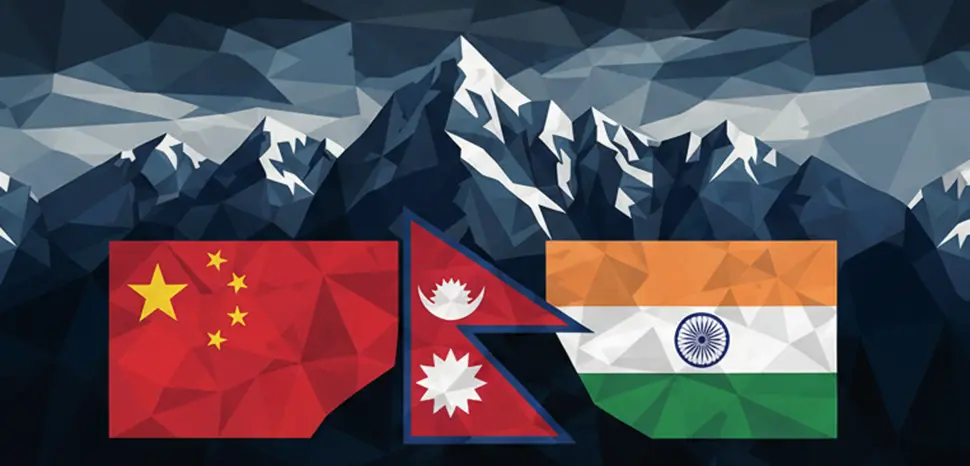
Nepal’s expanding military engagement with China is drawing attention to the changing security dynamics in the Himalayas, as Kathmandu seeks to maintain working relationships with both of its powerful neighbours.
Nepal Army Chief General Ashok Raj Sigdel visited China from September 13 to 19, attending the 13th Beijing Xiangshan Forum and holding talks with senior Chinese defence officials. During the visit, Sigdel met Chinese Defence Minister Admiral Dong Jun and visited China’s National Defence University, with discussions covering bilateral military relations and matters of mutual interest.
The visit was officially presented as part of Nepal’s military diplomacy and an effort to strengthen defence relations with China. It also comes as Beijing continues to expand its military-to-military engagement with Kathmandu, including joint training and professional exchanges.
For Nepal, cooperation with China can provide access to military training, professional exchanges and experience in areas relevant to a mountainous country, including disaster response and difficult-terrain operations. For India, however, the growing institutional contact between the Nepal Army and the People’s Liberation Army is relevant to the wider security environment along its northern frontier.
The development does not, by itself, indicate a strategic realignment by Kathmandu. Nepal has traditionally maintained defence and diplomatic relationships with both India and China, and its military has conducted exercises with several countries.
### A Longer Chinese Military Engagement
Nepal-China military cooperation predates General Sigdel’s latest visit. The two countries held their first joint military exercise, Sagarmatha Friendship, in 2017. The exercise focused on counter-terrorism and disaster response and was described by the Nepal Army as part of its broader programme of bilateral and multilateral military training.
A second edition followed in 2018, involving Chinese and Nepali special operations forces. Training included climbing, fast-roping, coordinated shooting, special driving and hostage-rescue exercises. Chinese military authorities described the training as a means of strengthening professional exchanges and mutual understanding between the two forces.
The exercises therefore have a practical dimension. Nepal faces earthquakes, landslides, avalanches and other hazards in difficult terrain, making military capabilities related to emergency response and mountain operations relevant to its own security requirements.
At the same time, repeated exercises create sustained contact between military institutions. Officer exchanges, training programmes and senior-level visits can establish professional relationships that extend beyond individual exercises.
That does not necessarily mean that military cooperation translates into political alignment. But it does give China another established channel through which it can develop relationships with Nepal’s defence establishment.
### Tibet and the Himalayan Border
China’s security interests in Nepal are also closely connected to Tibet. Beijing regards stability in Tibet as a major national-security concern and has long sought cooperation from neighbouring countries on border management and preventing activities it regards as threatening to Chinese sovereignty.
Nepal’s geography makes the country particularly significant in this context. Its northern frontier with China includes difficult Himalayan terrain, while its southern border with India is deeply connected to trade, migration and social ties.
For Beijing, stronger security cooperation with Kathmandu can therefore serve practical interests relating to border management and regional stability. For Nepal, cooperation with China can provide another avenue for addressing its own security and development requirements.
The strategic implications for India are more complicated.
India and Nepal have an unusually extensive defence relationship. The two armies conduct the Surya Kiran exercise, maintain regular institutional contacts and cooperate in training, equipment and disaster relief. India and Nepal also retain the longstanding practice of conferring honorary general ranks on each other’s army chiefs. In August 2026, Nepal conferred the honorary rank of General of the Nepali Army on Indian Army Chief General Dhiraj Seth.
These arrangements reflect the depth of the military relationship, but they do not eliminate the possibility of Nepal expanding its engagement with China.
### Kathmandu’s Balancing Act
Nepal’s position between India and China has long required careful diplomatic balancing. Kathmandu has sought economic, political and security relationships with both neighbours while maintaining its formal independence in foreign-policy decision-making.
General Sigdel’s China visit can be viewed within that broader framework. Nepal Army statements have described military diplomacy as contributing to the country’s foreign policy, while the visit itself was officially focused on strengthening Nepal-China military relations.
For India, the important issue is therefore not whether Nepal maintains relations with China. Kathmandu is unlikely to abandon its engagement with either neighbour simply because of concerns in the other capital.
The more consequential question is the scope and direction of that engagement over time.
Defence cooperation becomes strategically significant when training, equipment, institutional exchanges and security coordination develop into a sustained network of relationships. Whether that occurs in Nepal will depend on decisions made in Kathmandu as well as on the scale and nature of China’s future military assistance and engagement.
### What It Means for India
New Delhi has strong reasons to monitor the evolution of Nepal-China defence ties, particularly because of the two countries’ geographic proximity and India’s own security interests in the Himalayan region.
At the same time, treating every Nepal-China military contact as evidence of an anti-India alignment would overlook Nepal’s longstanding policy of maintaining relationships with both neighbours. The 2017 Sagarmatha Friendship exercise itself was presented by Nepal as part of a wider pattern of military cooperation with friendly countries, rather than as a substitute for its existing defence relationship with India.
For Nepal, the challenge is to obtain practical benefits from cooperation with both countries without allowing military or economic relationships to constrain its independent policy choices.
For India, the development presents a parallel challenge: maintaining its established defence relationship with Nepal while recognising Kathmandu’s interest in diversifying its external partnerships.
General Sigdel’s September visit is therefore significant less because it represents a formal shift in Nepal’s security alignment — there is no evidence in the sources reviewed of a Nepal-China military alliance or Chinese military base in Nepal — and more because it illustrates the steady institutionalisation of defence ties between Kathmandu and Beijing.
As China expands its military diplomacy across Asia, Nepal is likely to remain an important part of the Himalayan strategic equation. How Kathmandu manages its relationships with Beijing and New Delhi will determine whether the expanding defence engagement remains primarily practical cooperation or develops into a more consequential element of regional security politics.