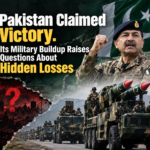

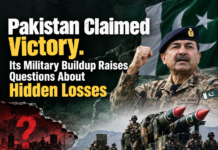





















Pakistan’s military has spent months portraying the May 2025 confrontation with India as a clear victory. Islamabad’s account emphasised successful strikes, limited Pakistani losses and the alleged failure of India to achieve its objectives.
Yet the story does not end with Pakistan’s victory declaration.
What followed the ceasefire is arguably more revealing. Pakistan moved rapidly to strengthen its rocket forces, bring Chinese Z-10ME attack helicopters into service and overhaul its senior military command structure. None of these developments independently proves the scale of Pakistani losses in May. But together, they raise a legitimate question: was Pakistan’s post-war military buildup partly an attempt to repair or compensate for weaknesses exposed during the confrontation?
That possibility deserves greater attention than the triumphal narrative coming from Islamabad.
Military establishments rarely publicise the full extent of wartime losses, particularly when those losses carry political consequences. Aircraft, air-defence systems, missile stocks, command facilities and other sensitive capabilities can be difficult to assess from outside, especially when both sides wage an intense information campaign alongside military operations.
Pakistan has had a strong incentive to emphasise success.
Islamabad named its operation Bunyan-un-Marsoos and presented it as a demonstration of military strength against India. The phrase, drawn from Quranic imagery of a firmly joined structure, was intended to convey unity, discipline and resolve.
Pakistan subsequently claimed that it had struck 26 Indian military targets, including locations such as Suratgarh, Sirsa, Naliya, Adampur, Bathinda, Halwara, Srinagar, Jammu, Udhampur, Ambala and Pathankot. It also claimed attacks on BrahMos-related facilities at Beas and Nagrota, S-400 air-defence systems at Adampur and Bhuj, a supply facility at Uri and military headquarters at KG Top and Nowshera.
Those claims were strongly disputed by India.
Foreign Secretary Vikram Misri described Pakistan’s account as a “malicious misinformation campaign” and rejected several assertions as “blatant lies”. Prime Minister Narendra Modi’s later visit to Adampur airbase, with the facility shown operating, was used by India to challenge Pakistan’s claims regarding damage there.
The competing versions of events make any definitive assessment of battlefield losses difficult. But that uncertainty cuts both ways. If Pakistan’s claims about Indian losses cannot simply be accepted without evidence, neither should Pakistan’s claims about its own limited losses.
This is where its actions after the ceasefire become important.
On August 13, 2025, Pakistan established the Army Rocket Force Command at General Headquarters in Chaklala. Guided rockets, cruise missiles and multiple-launch rocket systems were placed under a specialised command.
That is a significant organisational decision.
A dedicated rocket command can improve coordination, readiness and the concentration of long-range conventional firepower. For Pakistan, it also provides greater emphasis on precision strike capabilities that could be employed in a future confrontation with India.
The establishment of the command does not prove that Pakistan’s missile forces suffered heavy losses in May. Nor does it establish that the decision was conceived solely because of the conflict.
But the timing invites scrutiny.
If Pakistan emerged from May with the overwhelming military success it publicly claimed, one would still expect lessons to be drawn. The question is whether the scale and urgency of the subsequent changes are consistent with a military simply consolidating a victory—or with one that discovered vulnerabilities it could not afford to leave exposed.
The Z-10ME programme offers another useful example.
Pakistan had been attempting to replace its ageing AH-1F Cobra attack helicopters for years. Its effort to acquire Turkey’s T129 helicopters failed, leaving the requirement unresolved. The Chinese Z-10ME therefore cannot reasonably be described as a weapon suddenly purchased because of the May conflict.
But its rapid induction after the confrontation is nevertheless significant.
The helicopters arrived at Multan, with Field Marshal Asim Munir overseeing their induction and a live-fire demonstration subsequently conducted. The acquisition strengthens Pakistan’s battlefield aviation capability and adds another element to its conventional military modernisation.
Again, the evidence does not prove a direct causal link to losses suffered in May.
It does, however, contribute to a broader pattern.
The most consequential change came at the top of Pakistan’s military structure.
In November 2025, parliament approved the 27th Constitutional Amendment, abolishing the Chairman of the Joint Chiefs of Staff Committee and creating a stronger Chief of Defence Forces arrangement. Munir assumed the expanded position, while a National Strategic Command was created for strategic forces.
The restructuring has political and institutional dimensions that cannot simply be attributed to the India-Pakistan confrontation. Nevertheless, it followed a conflict in which the integration of air power, missiles, drones, intelligence and ground forces had been tested under intense pressure.
That makes the timing relevant.
Taken individually, Pakistan’s post-ceasefire decisions have straightforward explanations. The rocket command reflects military modernisation. The Z-10ME addresses a long-standing aviation requirement. The command restructuring has broader institutional motivations.
But taken together, they present a more interesting picture.
Pakistan did not simply declare victory and stand still.
It expanded and reorganised.
That distinction matters.
One possible explanation is straightforward modernisation. Another is that Pakistan’s military leadership identified weaknesses during the May confrontation and concluded that existing capabilities were insufficient for the next major encounter with India.
A third possibility is even more uncomfortable for Islamabad: that some of the subsequent measures were intended, at least in part, to replace, strengthen or reorganise capabilities affected during the fighting.
There is not enough publicly established evidence to determine the precise scale of Pakistani losses from the supplied record. It would therefore be irresponsible to turn military reforms into a numerical estimate of destroyed aircraft, missiles or installations.
But the absence of a complete public accounting does not make the question irrelevant.
In fact, it makes Pakistan’s post-war behaviour more important.
States routinely conceal sensitive military losses. They also have strong incentives to prevent an adversary from knowing the true condition of their armed forces. Publicly acknowledging significant losses can damage deterrence, morale and domestic political credibility.
Pakistan’s insistence that it suffered little while simultaneously strengthening key conventional capabilities should therefore be examined rather than dismissed.
The issue is not whether every new weapon or command structure represents compensation for a May loss. Clearly, they do not.
The issue is whether Pakistan’s actions reveal a military establishment preparing for the next India confrontation with greater urgency because the previous one exposed vulnerabilities that Islamabad would rather not discuss publicly.
That interpretation cannot yet be proved conclusively.
But it is entirely reasonable to consider.
Pakistan may continue to describe Bunyan-un-Marsoos as a decisive victory. Its official statements may continue to emphasise Indian losses and minimise Pakistani casualties and equipment losses.
Yet military history is often written not only through wartime communiqués, but through what armies do afterwards.
Pakistan’s post-ceasefire decisions point towards a military seeking more long-range conventional firepower, stronger battlefield aviation and tighter command integration.
Whether those changes were driven primarily by long-term modernisation, lessons from May, or the need to compensate for previously undisclosed losses remains a matter for further evidence.
What is clear is that Pakistan did not behave like a military with nothing left to fix.