













The Hague, Netherlands: The 6th Summit of the Inter-Parliamentary Alliance on China (IPAC) convened in The Hague, bringing together 52 lawmakers from 30 countries across six continents to discuss coordinated responses to the challenges posed by the People’s Republic of China (PRC). The summit underscored the need for the international community to move beyond expressions of concern and translate its commitments into concrete and coordinated action.
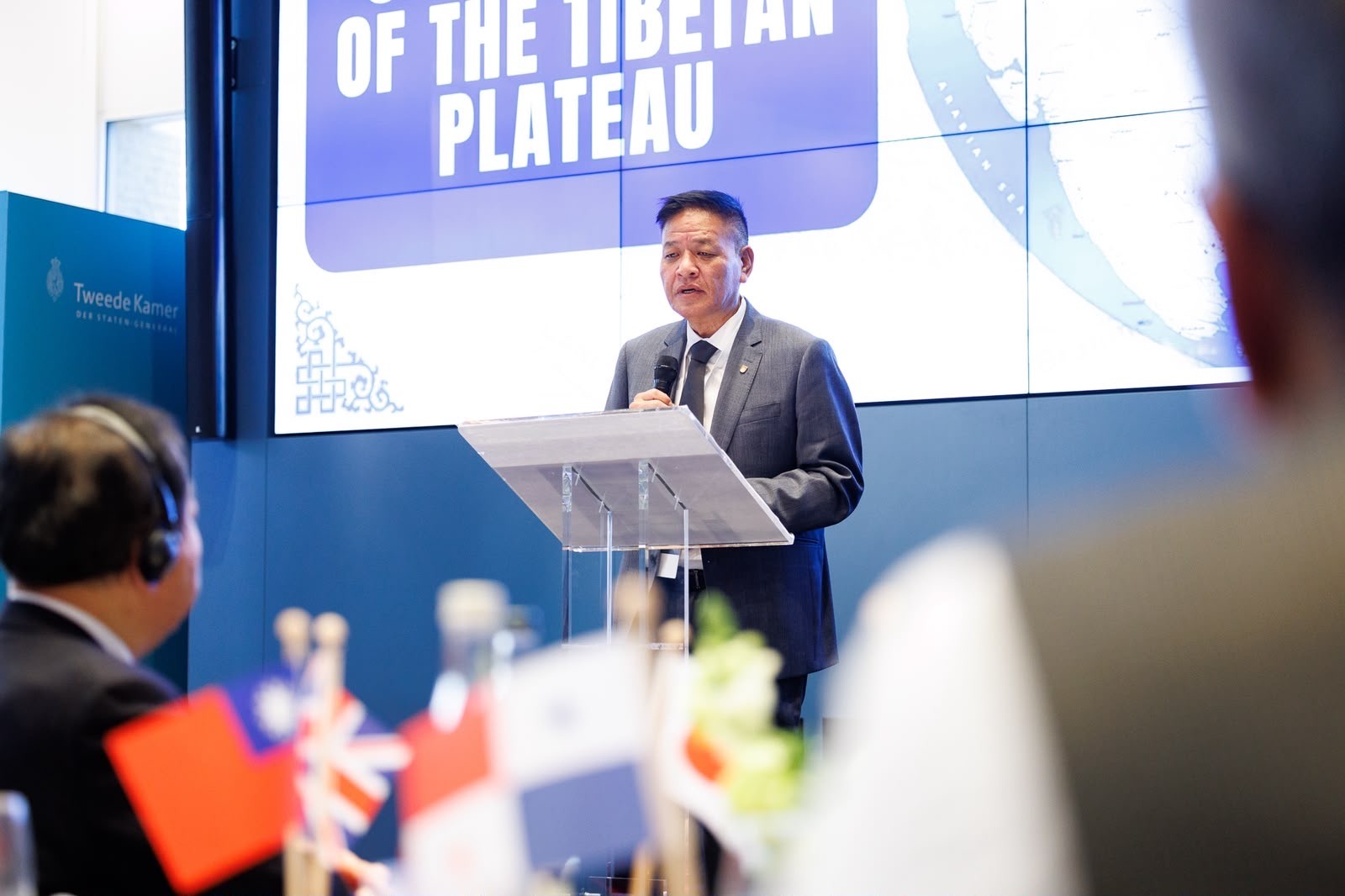
Delivering his address during a lightning session, Sikyong Penpa Tsering of the Central Tibetan Administration (CTA), accompanied by Representative Rigzin Genkhang, called on parliamentarians to develop a more accurate understanding of Tibet’s historical and political status. He drew attention to two significant publications: Tibet Was Never Part of China Since Antiquity by Chinese Professor Hon-Shiang Lau and Tibet Brief 20-20 by Professor Michael van Walt van Praag, urging lawmakers to examine Tibet’s history through objective historical and legal perspectives rather than relying on narratives advanced by the Chinese government.
Sikyong cautioned that China’s global initiatives reflect ambitions extending far beyond its borders, with significant implications for international democracy, security, freedom and the existing global order. He urged parliamentarians to closely examine the objectives and consequences of these initiatives and their implications for the international community.
Reaffirming the CTA’s commitment to the Middle Way Approach, Sikyong emphasised that the CTA continues to follow the vision and wisdom of His Holiness the 14th Dalai Lama in pursuing a peaceful, non-violent and mutually beneficial negotiated resolution to the Tibet-China conflict. He stressed that the pursuit of dialogue and reconciliation does not diminish Tibet’s historical and legal rights under international law. He also called on governments to counter China’s historical misinformation through appropriate legislation, parliamentary resolutions and official declarations, citing the United States’ Resolve Tibet Act as an important example.
Sikyong further raised serious concerns over China’s growing interference in the religious affairs of Tibetan Buddhists, particularly its attempts to politicise and control the reincarnation process of Tibetan Buddhist spiritual leaders, including the future reincarnation of His Holiness the 14th Dalai Lama. He urged parliamentarians to firmly oppose such interference and uphold the Tibetan people’s inherent right to determine the reincarnation of their spiritual leaders in accordance with their religious traditions and the wishes of His Holiness.
In this regard, he encouraged lawmakers to adopt positions similar to those taken by the United States and seven European countries—the United Kingdom, Germany, France, the Netherlands, Iceland, Lithuania and Estonia—which have expressed support for the religious freedom of Tibetan Buddhists and opposed Chinese government interference in the reincarnation process.
Highlighting the deteriorating situation inside Tibet, Sikyong warned that China’s forced assimilation policies pose an existential threat to Tibet’s distinct language, religion, culture and identity. He described these policies as amounting to cultural genocide and called on international lawmakers to take concrete measures to protect Tibet’s cultural heritage and the fundamental rights of the Tibetan people. He also drew attention to the environmental significance of the Tibetan Plateau, warning of the wider regional and global consequences of China’s large-scale infrastructure and hydropower projects.
Concluding his address, Sikyong called for sustained international solidarity and specifically urged Members of the European Parliament to work towards the appointment of an EU Special Representative for Tibet to strengthen and coordinate the European Union’s engagement on Tibet. He emphasised that the international community must move beyond statements of support and demonstrate its commitment through meaningful political and diplomatic action.
The lightning session also featured addresses by Rear Admiral Jay Tarriela, Spokesperson of the Philippine Coast Guard; Kit Conklin, Chief Strategy and Global Affairs Officer, Exiger; and Senator Eliot and Representative Candice Pierucci, who shared their perspectives on issues concerning China and its local and global implications.
On the sidelines of the summit, Sikyong held a separate meeting with Jan Paternotte, Co-Chair of the Inter-Parliamentary Alliance on China (IPAC) and a longstanding supporter of Tibet. He expressed his appreciation for Jan Paternotte’s continued commitment to the Tibetan cause and his efforts to advance parliamentary engagement on Tibet in the Dutch Parliament.
Sikyong also engaged with a strong contingent of lawmakers from Panama, exchanging views on China’s expanding global influence, its various international initiatives and the implications for the international community. The discussions highlighted the importance of greater international awareness and coordinated responses to China’s policies and actions.
Sikyong also met with Miriam Lexmann, a Member of the European Parliament and a member of the Interparliamentary Group for Tibet. He expressed his appreciation for her longstanding support for Tibet and the Tibetan cause and extended an invitation for her to visit Dharamshala in the near future.
Sikyong further engaged with parliamentarians from Japan, Taiwan, the United Kingdom, Romania, the Balkans and other countries, exchanging views and strengthening international ties and support for the Tibetan cause.
As part of his media engagements, Sikyong also gave a side interview to Shweta Sharma, Asia Correspondent of The Independent, offering an opportunity to highlight the Tibetan perspective on the issues discussed at the summit and reiterate the importance of sustained international attention and support for Tibet.
In the evening, Sikyong Penpa Tsering, Representative Rigzin Genkhang, and other members of the Tibetan delegation, including ICT President Tenchoe Gyatso, TPI Director Tenzin Lekshay and EU Advocacy Officer Tenzin Phuntsok, attended the IPAC reception dinner hosted at the King’s Ballroom, providing an opportunity to interact with participating parliamentarians and delegates from across the world.
The first day of the 6th IPAC Summit concluded with a clear message: the international community must move beyond words and expressions of concern and translate its commitment into concrete action in addressing China’s policies and their implications for Tibet and the wider world.