






















China’s celebration of naval power on April 23 every year is no longer merely ceremonial patriotism. It is strategic messaging. On this day, Beijing glorifies the People’s Liberation Army Navy (PLAN) through parades, speeches, and high-profile drills. Yet, it simultaneously signals coercive intent across the Indo-Pacific region.
Regional powers increasingly view this fusion of propaganda and projection as psychological warfare, one that is accelerating military preparedness, alliance-building, and a widening arms race.
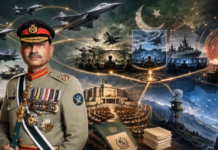
At the ideological core of this duality lies President Xi Jinping’s rhetoric. He has repeatedly framed the Chinese military as a “great wall of steel,” emphasising resilience, unity, and combat readiness. This language is not incidental. It transforms the PLA Navy into a symbol of national destiny and deterrence, blending nationalism with strategic signaling.
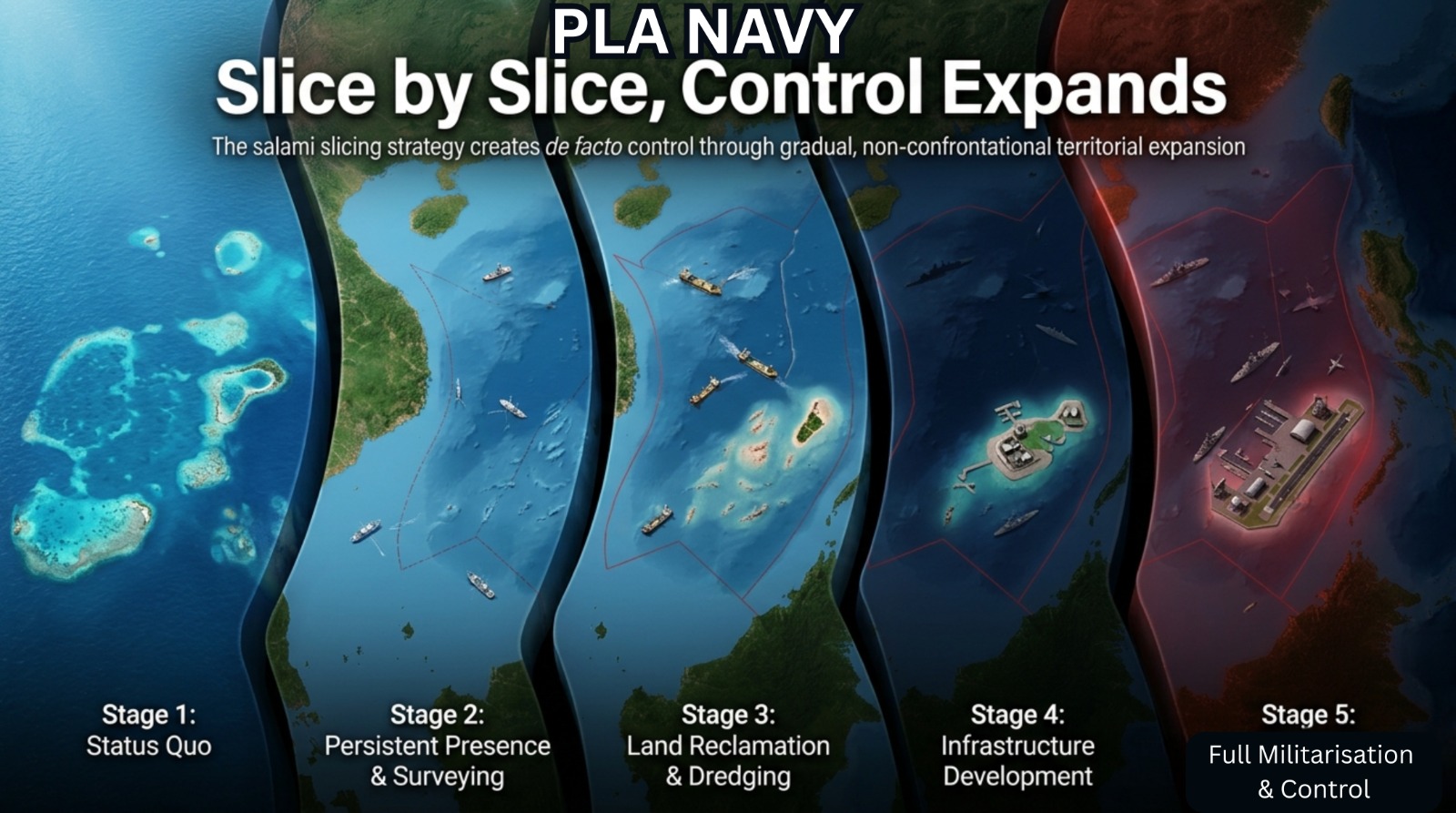
When amplified during Navy Day celebrations or state media coverage, this glorification projects strength outward while consolidating domestic legitimacy. Yet the operational reality tells a more assertive story. The PLAN’s activities have expanded far beyond coastal defence into aggressive blue-water manoeuvres.
In April 2026, Chinese warships transited waters near Japan’s southwestern islands and conducted drills in the Western Pacific, testing far-seas capabilities and raising alarms in Tokyo. Such proximity to Japanese territory underscores a deliberate effort to normalise Chinese naval presence near sensitive zones.
Further south, China’s 2025 live-fire drills in the Tasman Sea, within Australia’s exclusive economic zone, illustrate this assertiveness. Conducted with minimal notice, these exercises disrupted civilian air traffic and forced dozens of commercial flights to reroute.
Australian and New Zealand forces shadowed the Chinese flotilla, highlighting how Beijing’s actions compel real-time military responses. Similarly, Chinese naval groups operating near Australia have been routinely tracked by allied navies, reflecting growing mistrust and vigilance.
Around Taiwan, the pattern intensifies further. Large-scale exercises such as ‘Justice Mission 2025’ and other live-fire drills simulate blockades and joint-force operations, explicitly aimed at deterring “external interference.” These drills, often unannounced or expansive in scope, are widely interpreted as rehearsals for coercive scenarios, blurring the line between signaling and preparation for conflict.
For regional actors, these actions are not isolated. They form a pattern. Japan has responded by increasing defence spending and deepening cooperation with the United States and regional partners. Australia has accelerated its commitments under AUKUS, including nuclear-powered submarine development. Vietnam has expanded its submarine fleet, while India has strengthened maritime surveillance and operational coordination through the Quad framework.
This cascading response reflects a broader strategic consequence: China’s naval glorification is triggering an arms race. Regional military spending has surged, estimated to have risen by roughly 20% since 2020, driven by perceived threats from Beijing’s maritime posture.
The PLAN’s rapid modernisation, including aircraft carrier deployments beyond the first island chain and expanding overseas access points, reinforces the perception of a navy transitioning from regional defence to global power projection. Crucially, the psychological dimension cannot be overlooked. By celebrating naval strength while simultaneously conducting high-risk manoeuvres, Beijing cultivates an image of inevitability, suggesting that resistance is futile and dominance is assured.
This dual messaging aims to deter adversaries without direct conflict, leveraging perception as a force multiplier. However, the effect appears to be the opposite. Rather than acquiescence, China’s neighbours are hardening their positions.
Multilateral exercises, intelligence-sharing, and interoperability initiatives are expanding. The Quad, comprising India, Japan, Australia, and the United States, has gained renewed strategic relevance, while AUKUS represents a deeper technological and military integration aimed squarely at countering Chinese influence.
In essence, Beijing’s naval glorification is not merely symbolic. It is strategic signaling embedded within a broader coercive framework. By projecting strength through both rhetoric and action, China seeks to reshape the Indo-Pacific order. Yet in doing so, it is galvanising a collective response that may ultimately constrain its ambitions. The “great wall of steel” at sea, it seems, is not just a shield. It is a provocation.