



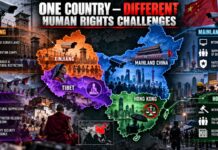
























China’s new Ethnic Unity Law is raising concerns that Beijing is extending its system of political and social controls beyond its borders, particularly against Uyghurs, Tibetans and other communities living abroad.
The law, adopted by China’s National People’s Congress on March 12 and effective from July 1, contains 65 articles aimed at promoting what Beijing defines as ethnic unity and national integration. Critics argue that several provisions give the Chinese state broad scope to regulate identity, expression and political activity while leaving key terms insufficiently defined.
The legislation places all 56 officially recognised ethnic groups within a single, Party-defined conception of the Chinese nation. Its provisions cover education, language, religion and public expression. Mandarin is given greater prominence from early childhood, while the law promotes the “Sinicisation” of religion and requires parents under Article 20 to raise their children to love the Communist Party.
Other provisions have raised concerns over freedom of expression. Article 31 prohibits information that undermines “ethnic unity and progress”, while Article 58 provides penalties for conduct deemed to undermine those objectives. Neither term is clearly defined in the legislation.
The most significant concern outside China may be Article 63, which extends liability to organisations and individuals beyond mainland Chinese territory. The provision does not specify particular conduct, identify a foreign jurisdiction or clearly restrict its application to Chinese citizens.
That potentially gives the law implications far beyond China’s domestic legal system.
For Uyghurs, Tibetans and other Chinese nationals living abroad, the concern is not necessarily that Chinese courts will directly prosecute them in Europe or North America. Rather, critics warn that the legislation could reinforce an existing system of pressure in which individuals abroad fear consequences for relatives still living in China.
The effect can be difficult to document. A relative may face questioning or restrictions on movement. Families may become reluctant to communicate openly. Activists may reduce their public activity to protect relatives. Researchers and witnesses may hesitate to speak publicly or attach their names to sensitive work.
In such circumstances, the effectiveness of the law may depend less on direct enforcement than on the perception that Beijing can reach beyond its borders.
The issue was raised ahead of Chinese President Xi Jinping’s recent visit to Washington. Omer Kanat of the Uyghur Human Rights Project argued that the legislation should be addressed not only as a human-rights issue but as a matter of American sovereignty.
US Senators Lindsey Graham and Sheldon Whitehouse had already written to Chinese Ambassador Xie Feng, warning that any attempt to pressure people living in the United States under Article 63 would constitute an unacceptable violation of American sovereignty.
Congressman Jim McGovern also called for human rights to be addressed during Xi’s visit.
Yet the issue did not feature prominently in the public account of the summit. The discussions instead focused on trade, artificial intelligence, Taiwan and international conflicts. Washington and Beijing extended their tariff truce by two months and agreed to meet again.
The absence of the law from the public discussion is significant because the concerns surrounding it are not limited to China’s internal affairs.
A state that attempts to influence the conduct of people living abroad by placing pressure on their relatives at home can create a problem for the countries in which those individuals reside. The issue becomes one of protecting people within a country’s jurisdiction from coercion originating overseas.
Europe has already taken a position on the legislation.
On April 30, the European Parliament voted 439 to 52 to condemn the law, called for its repeal, urged member states to suspend extradition treaties with China and asked the European Council to consider activating the EU Global Human Rights Sanctions Regime.
But political condemnation and practical enforcement are different matters.
The challenge for European governments is to determine how their existing laws can protect activists, journalists, researchers and diaspora communities from pressure that may not take the form of a conventional criminal offence.
Research by Michel Harb and Arne Wackenhut on Uyghur activists in Sweden has argued that transnational repression should be treated not merely as criminal conduct but as an infringement on the sovereignty of the host country.
Switzerland has reached a similar conclusion. Its Federal Council has warned that such pressure poses a significant long-term threat to Swiss sovereignty.
That approach provides European governments with a broader framework for responding to the problem. The issue is not simply whether China is restricting dissent within its own territory. It is whether a foreign state can use pressure against people or their relatives to influence behaviour inside another sovereign country.
Several responses could be pursued without requiring China’s cooperation.
European states could strengthen criminal provisions covering coercion carried out through intermediaries or relatives abroad. Immigration authorities could scrutinise international arrest requests where the underlying charges are connected to political or ethnic dissent. Governments could also coordinate their legal position on the extraterritorial provisions of China’s law through international institutions.
Collective action would carry greater weight than isolated objections. A single government can face considerable diplomatic pressure. A coordinated position involving multiple states would make it more difficult to treat the issue as a bilateral dispute.
The broader question is therefore not simply whether European governments should criticise China’s human-rights record.
It is whether they are prepared to defend the freedoms of people living within their own borders when those freedoms are threatened by pressure originating abroad.
That distinction is increasingly important.
The demonstrations surrounding Xi’s Washington visit illustrated the issue. Uyghur, Tibetan, Taiwanese and East Turkistani activists exercised political freedoms in the United States. Those freedoms exist because they are protected by the laws and institutions of the country in which the protesters live.
If those individuals can be pressured into silence because their relatives remain vulnerable in China, the consequences extend beyond China’s domestic political system.
They reach into the democratic societies where those communities have established their lives.
China’s Ethnic Unity Law therefore represents more than another piece of domestic legislation. Its provisions, particularly those concerning expression, ethnic unity and conduct outside mainland China, have raised questions about how far Beijing’s political and legal influence is intended to extend.
The critical issue now is whether governments in Europe and North America will treat those provisions as an internal Chinese matter or as a challenge to the protection of freedoms within their own jurisdictions.
The answer will determine whether the law remains primarily a mechanism of control inside China or becomes another instrument through which Beijing’s influence is felt abroad.