

























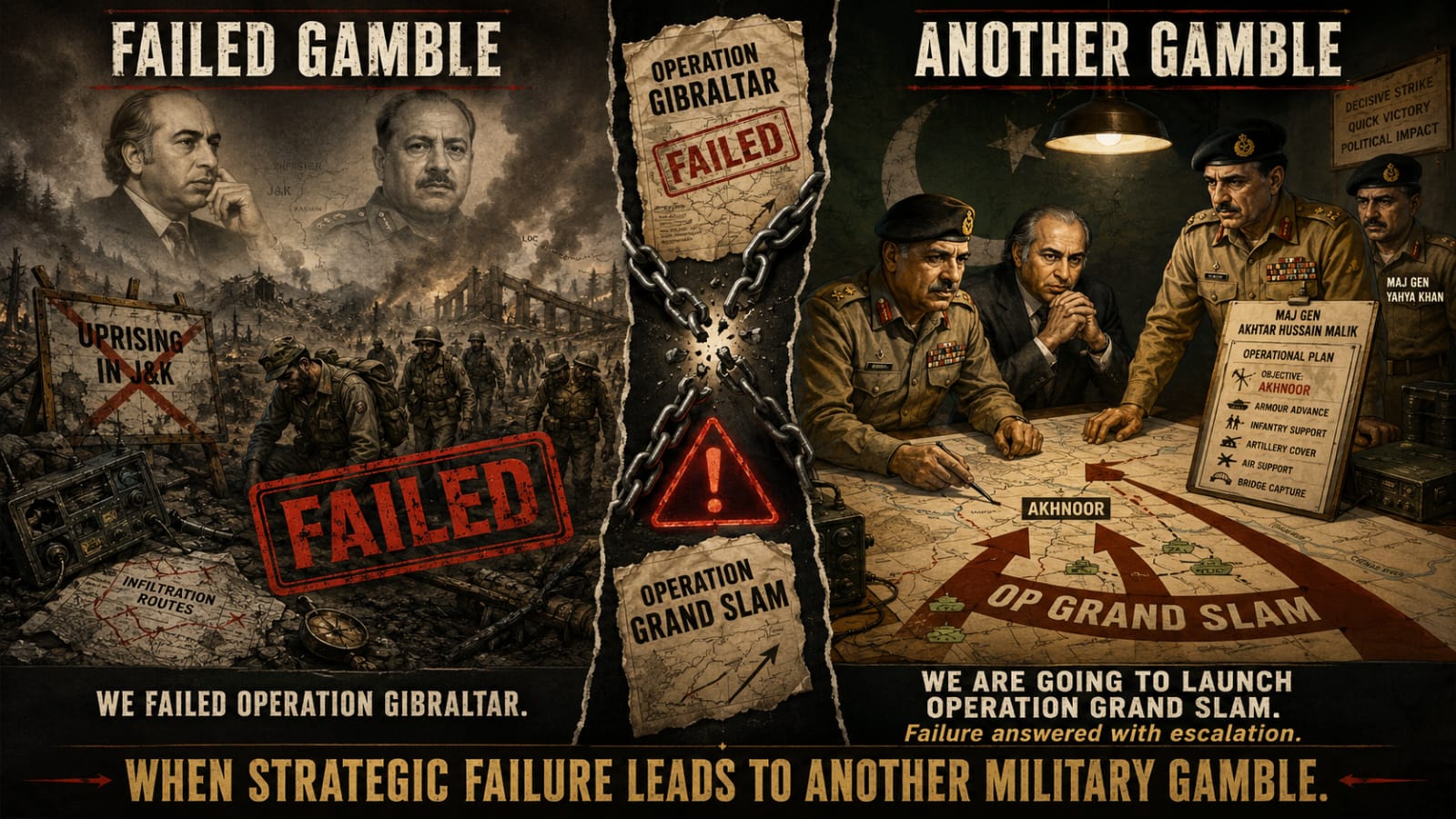
Operation Grand Slam failed primarily due to a combination of flawed strategic assumptions, sudden political and military leadership changes, and severe friction between Pakistan’s top commanders. Launched on September 1, 1965, the offensive aimed to capture the vital town of Akhnoor in Jammu and Kashmir to sever India’s main supply line. However, the operation ultimately stalled, allowing the Indian Army time to reinforce its positions and launch a massive counter-offensive in Punjab.
The critical factors that contributed to the failure of the operation are detailed below:
1. Poor Strategic Planning & Miscalculations
- Flawed Geopolitical Assumptions: Pakistan’s leadership mistakenly assumed that a localized conflict in Jammu and Kashmir would not trigger a full-scale war. They believed India would not cross the international border in Punjab, a miscalculation that proved disastrous when Indian forces opened the Lahore and Sialkot fronts on September 6.
- Loss of Momentum: The initial phase of the assault (led by Major General Akhtar Hussain Malik) achieved rapid tactical surprise. However, the strategic planners did not anticipate how quickly a sudden change in command would paralyze the advance, giving Indian forces a critical 24-to-48-hour window to reinforce Akhnoor.
2. Political Interference & Leadership Disputes
- The Sudden Change of Command: At the height of the offensive’s success, President Ayub Khan and the Commander-in-Chief, General Musa Khan, abruptly relieved Maj. Gen. Malik of his command, replacing him with Major General Yahya Khan. This mid-battle transition forced a temporary halt to the fighting, destroying the operational momentum.
- Internal Military Friction: The replacement of Malik by Yahya Khan remains one of the most controversial decisions in Pakistani military history. Analysts argue it was driven by internal military politics and favoritism—specifically to hand the glory of an impending victory to Yahya Khan, Ayub Khan’s preferred successor.
- Fear of Total War: Political leadership grew hesitant as the operation progressed, fearing that a decisive breakthrough at Akhnoor would push India into an all-out escalation. This hesitation resulted in mixed signals being sent to front-line commanders.
3. Logistical and Operational Failures
- Artillery and Armor Regrouping: The change in command required a complex regrouping of forces, artillery, and communication networks under a new headquarters. This administrative bottleneck allowed the Indian Army to rush the 20th Indian Brigade to shore up defenses at Akhnoor.
- Terrain and Obstacles: The advancing Pakistani armor faced difficult river crossings and terrain obstacles that required tight coordination. The operational pause caused by leadership disputes compounded these natural bottlenecks, turning a swift blitzkrieg into a sluggish war of attrition.