




























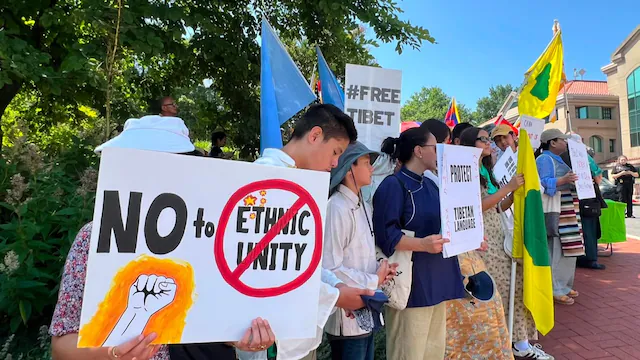
July 1, was no ordinary day for 16-year-old Tenzin Desang. A new law that claims to promote ethnic unity was coming into force in China, and the young Tibetan teenager could not help but wonder how, for her fellow Tibetans inside Tibet, their very way of life would become a crime from then on.She had spent the morning making protest placards at the office of Students for a Free Tibet (SFT) in New York before heading to the Chinese Consulate General, where she joined around 150 Tibetans, Uyghurs, Hong Kong activists and Chinese dissidents protesting against the new law.The demonstration was one of dozens held across the world against legislation that critics say provides a legal framework for the further forced assimilation of Tibetans, Uyghurs and other peoples whom Beijing classifies as “ethnic minorities”.
“This is not just another law. It is a dangerous escalation in the Chinese government’s efforts to erase the unique identities of Tibetans and all other non-Chinese nationalities,” Tencho Gyatso, president of the International Campaign for Tibet, told a rally outside the Chinese embassy in Washington, DC.
“This is not a law about ethnic harmony. It is a law about identity erasure. It is a law about who gets to define identity, and Beijing is seeking for only the Party to have that power,” she added.
China says the law is aimed at promoting national unity, social stability and ethnic harmony. Among its provisions are the promotion of Mandarin as the country’s common language, greater state oversight of “governing ethnic affairs”, and a clause allowing authorities to pursue legal action against individuals and organisations outside China accused of undermining so-called ethnic unity.
“What scares me the most is that this law gives China another tool to try to erase the Tibetan identity under the excuse of ‘ethnic unity and progress’,” the 16-year-old SFT New York-New Jersey board member told CNBC-TV18.
Desang said she first learnt about the law just days after this year’s Tibetan National Uprising Day on March 10.
“I remember feeling shocked, confused and scared,” she recalled.
“Every time the Chinese government uses words like ‘unity’ or ‘development’, Tibetans inside Tibet end up paying the price. Those words have been used to justify the closure of Tibetan schools, the expansion of colonial boarding schools, increased surveillance, and policies that try to erase the Tibetan identity and way of life,” Desang added.
The law has also drawn criticism from international human rights bodies and governments. United Nations High Commissioner for Human Rights Volker Türk and a group of UN human rights experts have called for the law to be repealed.
The European Parliament has also adopted a resolution condemning the law, urging member states to suspend extradition treaties with China over concerns that the legislation could be used to target individuals beyond its borders.
Rights groups say China’s education policies have moved beyond promoting Mandarin in schools to reshaping children’s linguistic and cultural environment from preschool onwards.
Human Rights Watch warned in May this year that the policies were putting “the survival of Tibetan language and culture at risk within a single generation.”
The protests stretched far beyond eight major cities in the US.
Demonstrations were organised in Toronto, Vancouver, London, Amsterdam, Brussels, Zurich, Oslo, Canberra, Melbourne, Sydney, Brisbane, Tokyo and several other cities, with protesters carrying Tibetan and Uyghur flags and calling for the repeal of the law.