




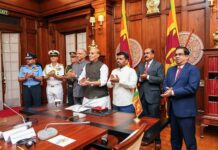



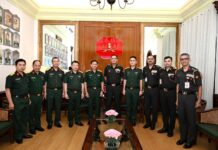











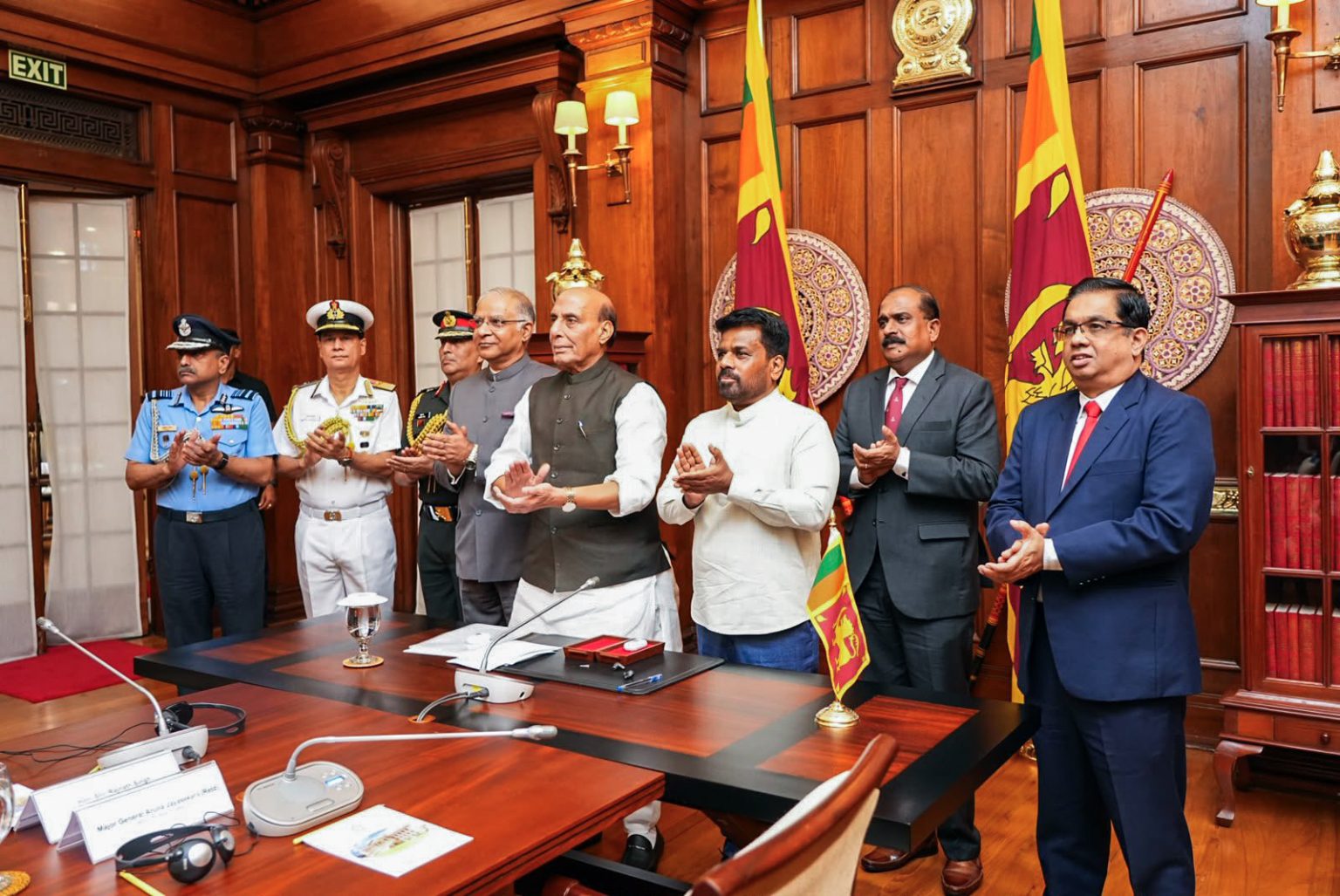
Defence Minister Rajnath Singh, on a three-day visit to Sri Lanka, met President Anura Kumara Dissanayake in Colombo and reaffirmed India’s commitment to strengthening bilateral cooperation for the development and well-being of the people of both countries.
Sharing details of the meeting on social media, Rajnath Singh said he conveyed Prime Minister Narendra Modi’s greetings to the Sri Lankan President and congratulated him on the completion of two years of his government.
The Defence Minister described India and Sri Lanka as “civilized twins, close neighbours, and maritime partners” and said both sides had reaffirmed their resolve to work together for the security, safety, peace and prosperity of the region.
During his visit, Singh also addressed members of the Indian community in Sri Lanka, where he highlighted India’s economic transformation and growing global trade footprint.
Singh said India had concluded free trade agreements with 38 countries over the past decade under the leadership of Prime Minister Narendra Modi, compared with comprehensive trade agreements signed with four countries during the previous UPA government.
Highlighting India’s trade engagement with major economies, the Defence Minister referred to the recently signed India-European Union Free Trade Agreement as the “mother of all deals”, saying it opens access to the large European market.
He also noted that India’s Free Trade Agreement with the United Kingdom has been implemented.
Speaking about India’s broader economic growth, Singh said the country remains among the fastest-growing major economies in the world and contributes more than 16 per cent to global growth.
He said India’s economy had doubled from around USD 2 trillion in 2014 to approximately USD 4 trillion over the past decade. India’s economy grew by 7.8 per cent in the first quarter of Financial Year 2026-27, he said, despite global economic challenges.
Singh also said average inflation had remained around 4.7 per cent over the past 12 years, compared with 10-11 per cent earlier.
Highlighting India’s manufacturing and export growth, the Defence Minister said the value of goods and services exports increased from Rs 45 lakh crore in 2014 to Rs 79 lakh crore in FY 2025-26.
Electronic goods production increased from Rs 1.9 lakh crore to more than Rs 11 lakh crore, while exports rose by around 700 per cent to over Rs 3 lakh crore, he said.
Singh said India had also emerged as the world’s second-largest mobile phone manufacturer, with the number of manufacturing units increasing from two to more than 300. Mobile phone manufacturing has grown to Rs 5.5 lakh crore, while exports have risen nearly 163 times to Rs 2.6 lakh crore, he said.
He also highlighted growth in the automobile sector, with annual exports reaching Rs 1.20 lakh crore.
On defence manufacturing, Singh said India’s defence exports had reached an all-time high of approximately Rs 39,000 crore, compared with around Rs 600 crore 12 years ago.
He said India’s defence budget had increased from around Rs 2 lakh crore in FY 2013-14 to Rs 7.25 lakh crore in FY 2025-26, reflecting the country’s efforts towards greater self-reliance in defence production.
Singh also highlighted India’s startup ecosystem, saying the country now has the world’s third-largest startup ecosystem, with the number of unicorns continuing to grow.
Referring to structural reforms, the Defence Minister cited the implementation of the Goods and Services Tax (GST), which established the “One Nation, One Tax” framework.
He also highlighted government welfare measures, saying around 25 crore people had been lifted out of poverty and social security coverage had expanded to around 95 crore citizens.
Singh further highlighted the expansion of India’s digital public infrastructure, including broadband connectivity, the Unified Payments Interface (UPI), the Jan Dhan-Aadhaar-Mobile (JAM) framework and Direct Benefit Transfer (DBT).
He said Rs 51 lakh crore had been directly transferred into citizens’ bank accounts through the DBT mechanism.
The Defence Minister also referred to infrastructure development, including the expansion of electrified railway networks and other transport infrastructure.
Sri Lankan Cabinet Minister Saroja Savithri Paulraj, Western Province Governor Hanif Yusoof, Deputy Minister Sundaralingam Pradeep, High Commissioner of India to Sri Lanka Santosh Jha, senior Indian civil and military officials and members of the Indian community attended the event.