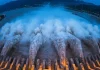





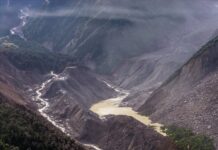





















The recent Tibet-Nepal massive flash flood on 26 August claimed thousands of lives. It caused catastrophic damage to property and infrastructure along Tibet’s Kyidrong Valley, Nepal’s Rasuwa District, and downstream settlements.
Pictures and videos showing the devastating force of the glacial torrent as it inundated and engulfed everything in its way are a clear warning that the Tibetan Plateau—known as the “Water Tower of Asia” and the “Third Pole of the Earth“—is not safe in the hands of the Chinese Communist Party (CCP)’s regime.
As of now, based on media reports from Nepal, at least 1,287 people, including foreigners, have been killed, and more than 5,000 are missing. Full efforts are being made to expand relief work with the support of the international community.
On the Tibet side of the border, however, information from China has been limited from the start. It initially reported three dead and 558 missing; now it is 43 dead and 519 missing.
International Campaign for Tibet Director Tenchoe Gyatso has rightly said, “What is visible in Nepal exposes what is being concealed in Tibet.”
A global press watchdog has condemned China’s information blackout of Tibet during the devastating flash flood crisis. Beijing barred international media from entering the region for around ten days after the disaster, for fear that the real situation and cause of the devastating flood would be revealed.
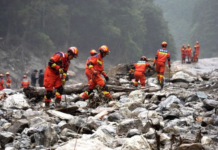
The CCP is more interested in saving its image. That is why we see many videos and pictures showing Chinese rescue teams in full professional gear and helicopters hovering, but with no information on what they are actually doing.
Beijing has also reported that the disaster originated on the Nepal side.
Tibet’s Ecological Importance
Since ancient times, Tibetans have preserved and worshiped the mountains, rivers, and forests. This has greatly helped maintain the required ecological balance, allowing the glaciers, lakes, and rivers to stay in harmony with the people.
Tibet is the source of some ten major rivers that nourish more than 2 billion people downstream. The Indus, Sutlej, Ganges, and Brahmaputra are major rivers and tributaries flowing to India, Nepal, Bhutan, Pakistan, and Bangladesh.
In the east, the Huang He and Yangtze rivers of China; the Mekong River that flows through China, Myanmar, Laos, Thailand, Cambodia, and Vietnam; and the Salween River that flows through China, Myanmar, and Thailand originate on the Tibetan Plateau.
A Zone of Peace
H.H. the Dalai Lama proposed in 1987 that Tibet be a zone of peace, a fully demilitarized autonomous state, to serve as a peaceful buffer state and another Geneva to discuss world peace and resolve international differences.
This would have greatly helped avert many of the violent clashes and man-made natural disasters that we saw along the borders that Tibet shares with Nepal, India, and Bhutan.
For centuries, the riparian nations in the south enjoyed a steady flow of fresh river waters from Tibet and peaceful coexistence and exchange along the borders. This was what H.H. the Dalai Lama dreamt of reviving for peace in the regions and for the world.
But the modern world, in the name of national interest, acquiesced to the fiery red dragon’s whim, and what we are seeing is the result of the dragon’s noxious and deadly hegemonic fumes.
Militarization and Environmental Damage
Contrary to what the Dalai Lama proposed, China has militarized the Tibetan Plateau and exploited its natural resources through extensive mining, deforestation, and damming.
To further fortify its claim on Tibet, the regime has built more than 650 dual-purpose settlements, housing military personnel and forcibly displaced nomads, along the southern borders with Nepal, India, and Bhutan.
Growing International Concerns
Tibetans and environment scientists have warned that the increased military, mining, damming, and infrastructural buildings could trigger ecological disaster in the region, affecting the lives of millions of people of the downstream nations.
Many have raised this question at the annual UN Climate Change Conference, but the CCP regime, bent on its hegemonic ambition to exploit and control the Himalayan region, has continued to ravage the Tibetan plateau.
Brahma Chellanney, an Indian geo-strategist and author of Water: Asia’s New Battleground, has said that the Tibet-Nepal flood disaster is a stark reminder that humanity must stop trying to bend nature to its will.
Penpa Tsering, Prime Minister of the Central Tibetan Administration, warned in a recent talk in Delhi about the potential environmental consequences of China’s large-scale dam and infrastructure projects in Tibet for downstream countries.
Separately, Nepal Prime Minister Balendra Shah said that questions about why the ice and rock collapsed and how such a large volume of water was generated must be answered by the global community.
Nepal’s Foreign Minister Shisir Khanal has rightly stressed that as China, India, and Nepal face similar environmental challenges and share the same ecosystem, they should take collective responsibility for addressing climate change in the Himalayas.
Furthermore, a senior UN official has warned that the Himalayan region faces severe risks from future glacial floods.
Beijing’s Narrative
The CCP regime’s mouthpiece, Global Times, has said that glacier disasters could become more frequent as global warming further weakens glacier stability on the Tibetan Plateau, in an apparent attempt to suggest that China has had no hand in the recent disaster.
To pass off the devastating disaster as a usual natural disaster, Gao Rong, Deputy Director of the China Meteorological Administration, is reported to have said that global warming is accelerating the melting of mountain glaciers worldwide.
Just as in the January 2025 earthquake in Tibet, instead of finding the real cause of the disaster, Beijing is suppressing information and trying to control the narratives. It is shying away from responsibility by attributing the disaster to global warming, but the question here is what induced the warming in the region.
A major factor is the increased militarization, mining, damming, and infrastructural construction on the Tibetan Plateau by the CCP regime.
This time, it was not only a glacial collapse, but a collapse of the rock beneath, a clear indication that the constant damming and mining have weakened the stability of the mountains’ bedrock, giving way to the pressure of the glacier.
Holding China Accountable
It is reported that Beijing is mulling a bid to host UN climate talks in 2028 (COP33). This is a great relief and, at the same time, alarming.
It is a relief because hosting the talks could provide an opportunity to hold Beijing accountable, but alarming because it may misuse the forum to justify its wrongdoings on the Tibetan Plateau.
This is exactly what China did with the 2008 Olympic bid, and the world supported it with the hope that the Olympics would help integrate China into international democratic norms and values—but what we see right now is exactly the opposite.
This flood disaster is a strong warning not only to Nepal, India, Bhutan, and Bangladesh, but also to all the Mekong nations of Laos, Cambodia, Vietnam, Thailand, and Burma.
If the CCP regime keeps militarizing the Tibetan Plateau and its border, mining minerals, cutting trees, and damming the rivers, such disasters are bound to occur from time to time. These disasters are not mere natural calamities, but Chinese-made disasters.
Instead of conducting relief work and helping displaced people, China is arresting and punishing people for posting and sharing information about the flood on social networks. It even condemned the Spanish football club Real Madrid for observing a moment of silence in memory of the victims of the devastating flood.
Tibetans and Japanese gathered on September 5 for a prayer service for those who lost their lives and were affected by the disaster at Tibet House in Tokyo.
Many voiced that China should be held responsible for this man-made disaster because of its rampant colonial-style hegemonic activities on the Tibetan Plateau. Many also felt indignant that China did not warn Nepal despite having enough time to do so.
H.H. the Dalai Lama, while praying for the victims of the flood and the early recovery of the situation, reminded us that we all have a responsibility to take appropriate follow-up measures to ensure that such disasters do not recur.
The international community needs to ensure that those affected in Nepal and Tibet are adequately rehabilitated, and Beijing must be held accountable for this devastating disaster and warned not to further damage the ecology of Tibet.
This flood disaster should be one of the core issues during the upcoming 2026 United Nation Climate Change Conference (COP31) this November in Turkey.