










The formal end of the Second World War in the Pacific occurred on 2 September 1945 aboard the battleship USS Missouri in Tokyo Bay. There, Japanese representatives signed the Instrument of Surrender in the presence of Allied commanders. The ceremony was conducted under the authority of the Supreme Commander for the Allied Powers, General Douglas MacArthur of the United States. China’s representative, General Hsu Yung-chang of the Republic of China, stood among the Allied signatories. He was present as one partner in a coalition, not as the architect of Japan’s defeat. Victory Day belongs to the Allies who forced Japan’s surrender; it is not the exclusive property of later Chinese Communist Party commemorations that rewrite the historical record.
The setting itself underscores the reality of power. The Missouri was an American warship anchored in Japanese waters after a campaign of naval supremacy, island-hopping, submarine blockade and strategic bombing that had brought Japan to its knees. American forces dominated the proceedings. Representatives from the United Kingdom, the Soviet Union, Australia, Canada, France, the Netherlands and New Zealand also signed, reflecting the multinational character of the victory. China’s participation affirmed its status as one of the Allies and acknowledged the long suffering of the Chinese people. It did not imply that Chinese armies had delivered the decisive blows that compelled Tokyo to capitulate. Those blows came primarily from American naval and air power across the Pacific, culminating in the atomic bombings and the final collapse of Japan’s ability to continue the war.
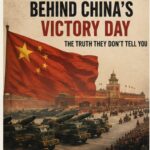
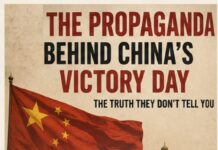
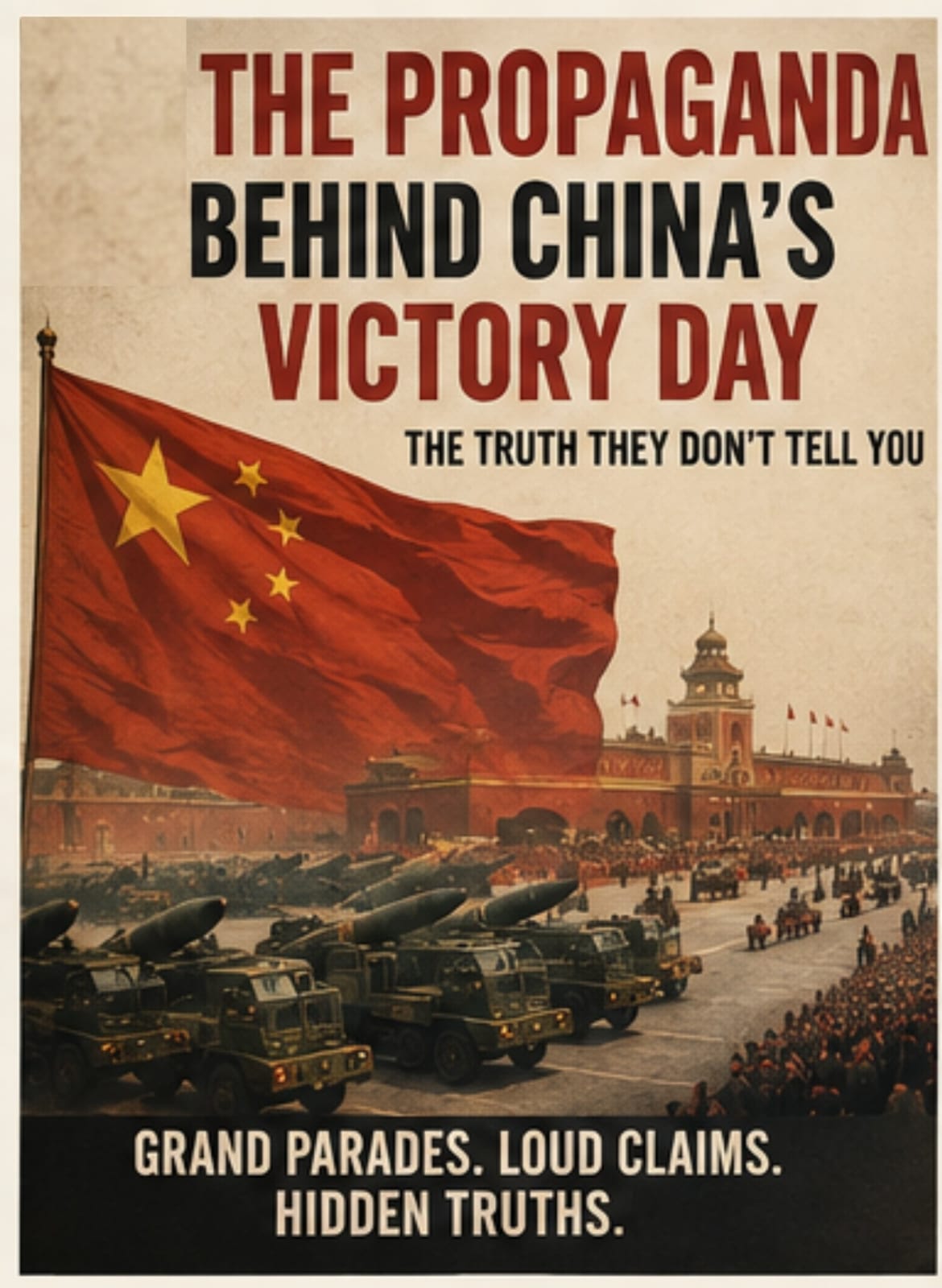
Contemporary Chinese Communist Party narratives present a different picture. Official commemorations of the “Chinese People’s War of Resistance Against Japanese Aggression” systematically elevate the role of Communist guerrilla forces while diminishing the far larger conventional burden borne by Nationalist armies. In CCP historiography, the Party is portrayed as the principal leader of the resistance, the organizer of the people’s war and the true victor. The Nationalist government of Chiang Kai-shek is often depicted as passive, corrupt or even collaborationist, despite having fielded the main regular armies that confronted Japanese divisions in major battles from Shanghai to Wuhan to the prolonged defence of the interior.
This selective emphasis distorts the military reality. From 1937 onward, the Nationalist forces absorbed the overwhelming share of conventional combat against the Imperial Japanese Army. They suffered the bulk of the casualties in large-scale engagements, held the formal government and international recognition and maintained the front that prevented Japan from achieving a rapid conquest of China. Communist forces, operating largely in rural base areas behind Japanese lines, conducted guerrilla warfare, sabotage and political mobilisation. These activities harassed Japanese garrisons and contributed to attrition, but they did not shoulder the primary responsibility for confronting Japan’s main field armies in sustained conventional operations. After 1941, as the broader Pacific War unfolded, the Communists also devoted significant energy to expanding their own territorial control and preparing for the postwar struggle against the Nationalists.
CCP accounts further minimise the decisive external contributions that sustained China’s resistance and ultimately ended the war. American Lend-Lease aid provided critical supplies, vehicles and equipment to Chinese forces. The American Volunteer Group better known as the Flying Tigers under Claire Chennault achieved early tactical successes against Japanese aircraft at a time when Chinese air power was nearly non-existent. Later, the U.S. 14th Air Force continued air operations from Chinese bases, interdicting Japanese logistics and supporting Chinese ground troops. The perilous airlift over “the Hump” from India kept a trickle of supplies flowing into China when land routes were cut. These efforts, though limited by geography and competing priorities, were vital.
-2-
More importantly, the wider Pacific campaign American carrier battles, the destruction of Japan’s merchant fleet by submarines, the capture of the Marianas, the firebombing of Japanese cities and the atomic strikes destroyed Japan’s capacity to wage war. Without that external pressure, the stalemate on the Chinese mainland would have persisted.
By elevating guerrilla actions and Party leadership while downplaying Nationalist sacrifices and Allied (especially American) power, official commemorations transform a coalition victory into a national myth centred on the CCP. The formal surrender ceremony on the Missouri stands as a factual rebuttal. China was represented because it was an Ally that had fought and suffered; it was not the power that had broken Japan’s navy, strangled its economy or forced the emperor’s decision to surrender. The Nationalist armies carried the heavier conventional load inside China; American forces delivered the strategic knockout across the Pacific.
A clear-eyed view of 2 September 1945 restores proportion. The Chinese people endured enormous hardship and contributed to the Allied cause by resisting Japanese occupation for eight years. Their endurance mattered. Yet the instrument of surrender was signed under American auspices on an American battleship because American power had made continued Japanese resistance impossible. Victory Day is an Allied achievement. Attempts to conscript it into a narrower propaganda narrative do not change the historical sequence of events or the distribution of military effectiveness that brought the war to an end.