































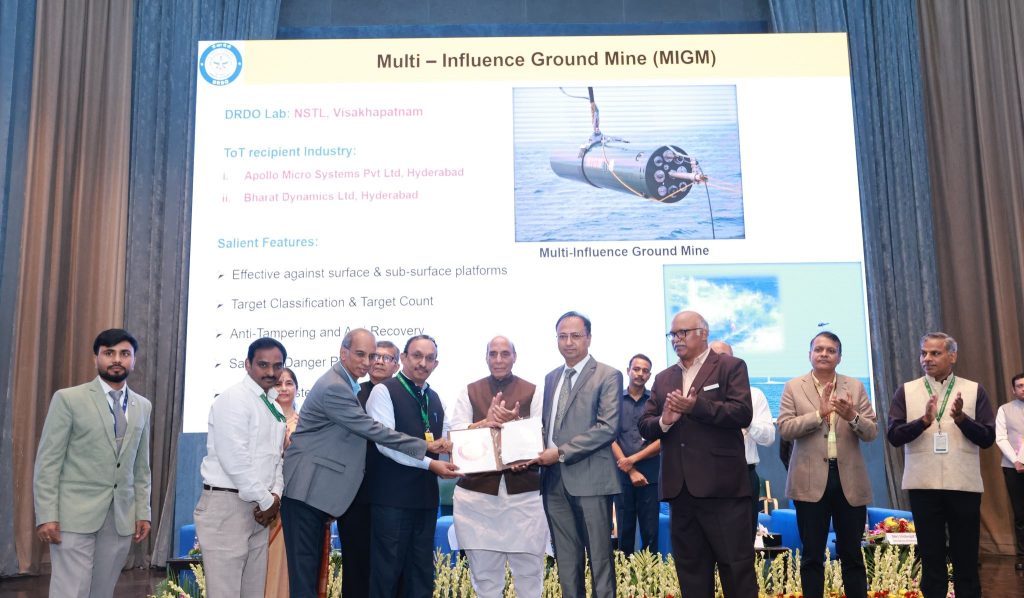
Defence Minister Rajnath Singh on Tuesday unveiled a series of policy initiatives aimed at lowering technical and financial entry barriers for MSMEs and deep-tech start-ups and launched a framework for sharing DRDO-developed software source codes with licensee industries at the DRDO-Industry Synergy Meet ‘VIMARSH 2026’.
The initiatives include direct funding, incubation support and dedicated access to DRDO testing facilities for MSMEs and start-ups. A standardised and secure framework for sharing software source codes with licensee industries was also launched to accelerate software-defined defence capabilities and address technology obsolescence.
Nine Licensing Agreements for Transfer of Technology (LAToTs) were handed over to 13 manufacturing partners in the presence of the Defence Minister, enabling commercial production of advanced defence systems.
Strategic MoUs were also exchanged with the Society of Indian Defence Manufacturers (SIDM) and Laghu Udyog Bharati (LUB) to expand industry outreach and promote participation at the grassroots level. The DRDO also signed a contract with the Quality Council of India for System for Advance Manufacturing Assessment and Rating (SAMAR) version 2.0 to benchmark the manufacturing maturity of domestic defence enterprises.
Addressing the gathering, Singh said DRDO-industry collaboration should extend beyond production to cover the entire value chain, including research, design, testing, certification and manufacturing, to help transform India into a global defence manufacturing hub.
“DRDO possesses knowledge and technology, the industry has scale and manufacturing capability, start-ups bring innovation and agility, and the youth hold the dream of a New India. When these four forces converge and move forward together, no goal is impossible,” he said.
Singh said the goal of Viksit Bharat was not limited to building an economically strong nation but also included technological self-reliance, social inclusion, environmental sustainability and strategic security.
“By 2047, we must achieve Aatmanirbharta in critical technologies, a significant increase in indigenous content, multi-fold growth in defence exports, and a robust presence for India in global supply chains,” he said.
The Defence Minister highlighted reforms undertaken in the defence sector under the leadership of Prime Minister Narendra Modi, including the Positive Indigenisation Lists, Make in India, iDEX, ADITI and the decision to allocate 25 per cent of the defence R&D budget to the private sector to reduce import dependence and promote self-reliance.
He said grants were being provided to start-ups through the Technology Development Fund and several technologies had already reached the production stage. Singh also highlighted iDEX for creating an ecosystem in which start-ups develop solutions based on actual operational requirements.
Describing start-ups and MSMEs as key drivers of innovation, Singh said they were playing an important role in achieving Aatmanirbhar Bharat by developing components, sub-systems and advanced technologies for major defence systems. He stressed the need to integrate them into the defence supply chain alongside large industries.
According to Singh, the new initiatives focus on promoting industry-led R&D, providing funding and mentorship to start-ups and MSMEs, strengthening academia-industry collaboration and encouraging investment in emerging technologies such as artificial intelligence, quantum computing, hypersonics and directed energy.
As India transitions from a defence importer to an exporter, MSMEs and start-ups can play a key role in areas such as drone technology, AI and cybersecurity, he said.
“MSMEs are the backbone of the Indian economy and a critical strength of the defence ecosystem. They need to consistently focus on quality, delivery, innovation, and global standards, while expanding partnerships with large companies,” Singh said.
He emphasised that self-reliance in technology should become an integral part of the country’s character and attitude, adding that companies investing in emerging technologies today would become tomorrow’s leaders.
“In future warfare, the country that leads in technology will secure the strategic advantage,” he said.
Defence Secretary and Secretary, Department of Defence R&D, and DRDO Chairman Rajesh Kumar Singh said VIMARSH 2026, centred on the theme ‘Varta se Vikas’, was designed to align commercial innovation with national defence readiness and integrate private-sector capabilities into the defence ecosystem.
The forum, he said, sought to move the national security framework beyond a transactional buyer-seller relationship towards a collaborative and co-created technology ecosystem.
Rajesh Kumar Singh also highlighted the transformation of the defence sector through the government’s self-reliance efforts. He said the expansion of technology transfers had enabled parallel production lines to meet the requirements of the armed forces and benefited MSMEs.
“Till date, over 2,300 Technology Transfers (ToTs) have been handed over to more than 1,100 industries. Currently, we have made technologies related to approximately 50 missiles, developed by DRDO, available to the industry to foster increased participation,” he said.
A book titled ‘Defence Systems for Resilient Bharat – Advancing Aatmanirbharta in Defence’, documenting major defence systems developed by DRDO’s technology clusters between 2014 and 2026, was also released at the event.
Guidelines for Human Resource Outsourcing Service Contracts in DRDO were released as well. The guidelines provide a framework for service specifications, procurement, selection of service providers, contract administration, performance monitoring and compliance with contractual and statutory obligations for human resource outsourcing across DRDO laboratories.
Secretary (Defence Production) Sanjeev Kumar, Secretary (Defence Finance) Vishvajit Sahay and Distinguished Scientist and Director General (Production Coordination & Services Interaction), DRDO, Dr Chandrika Kaushik, were present at the event.
During technical sessions, Directors General of DRDO technological clusters outlined roadmaps covering aeronautical systems, missiles, armaments, microelectronics and naval systems. DRDO headquarters also introduced measures aimed at simplifying procedural compliance, expediting access to facilities and reducing licensing timelines.
A high-level panel discussion involving senior representatives from the DRDO, Department of Defence Production and the armed forces focused on accelerating technology absorption, optimising Development-cum-Production Partner models and ensuring faster induction of indigenous technologies into active service.
The event was attended by more than 250 defence industry leaders, industry chamber representatives, senior civil and military officials and DRDO scientists. The Secretary, Department for Promotion of Industry and Internal Trade (DPIIT), also participated in the meet.
VIMARSH 2026 was organised to strengthen India’s defence-industrial framework by providing a platform to align DRDO’s technological research and emerging deep-tech start-ups with the established manufacturing ecosystem and facilitate greater private-sector participation.