




























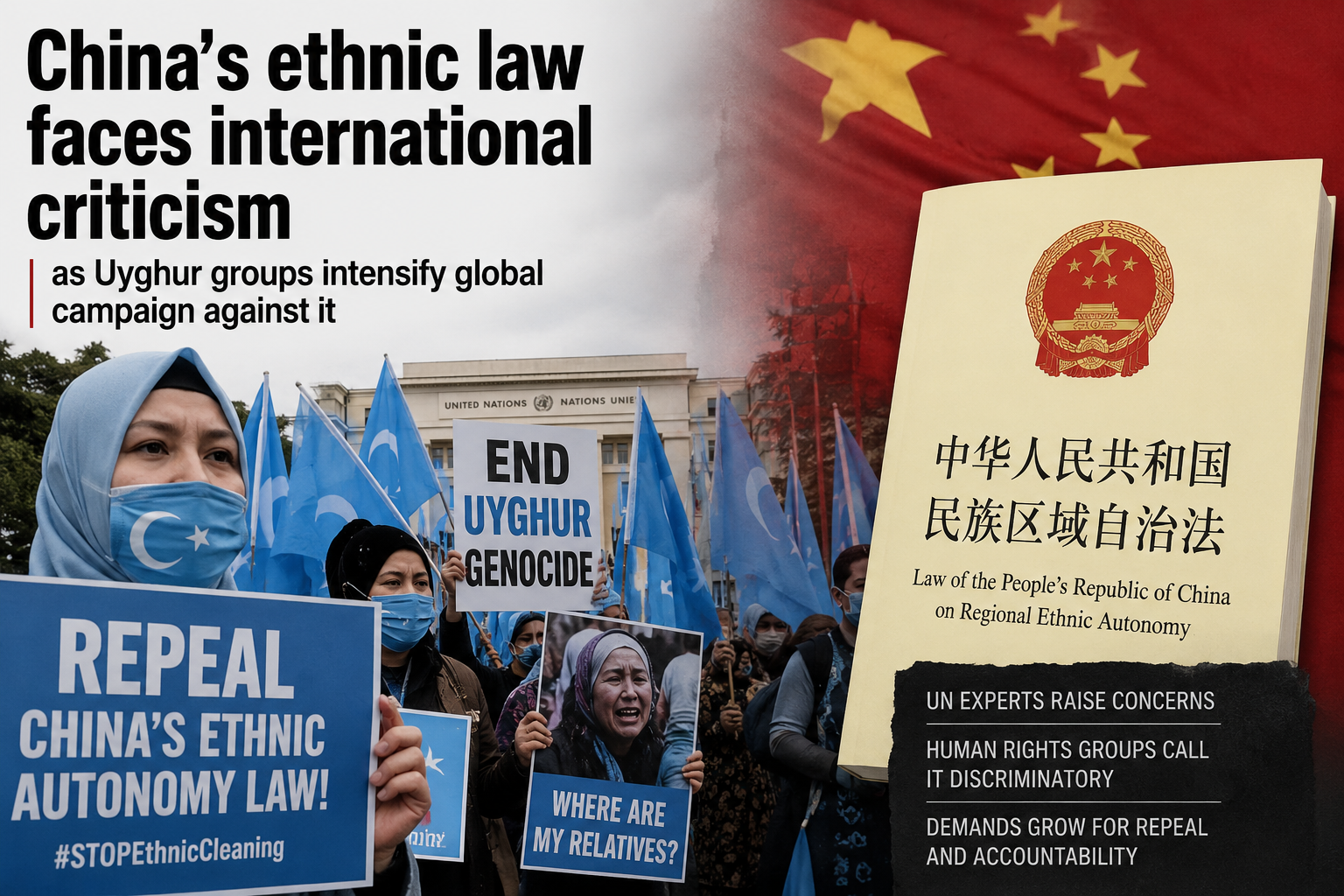
China Ethnic Unity Law has come under increasing international scrutiny as the World Uyghur Congress (WUC) intensifies its global advocacy campaign, arguing that the legislation institutionalises forced assimilation, undermines minority rights, and expands Beijing’s ability to target critics beyond its borders.
During a three-day advocacy visit to Stockholm from June 26 to 28, senior representatives of the WUC and affiliated organisations met Swedish officials, lawmakers, and civil society representatives to discuss the human rights situation in East Turkistan.
The delegation included WUC President Turghunjan Alawdun, Vice President Zumretay Arkin, Uyghur Centre for Democracy and Human Rights (UZDM) President Dolkun Isa, and Sweden Uyghur Union President Bahtinor Abdurehim.
The delegation held discussions with Sweden’s Ministry for Foreign Affairs, Member of Parliament Yusuf Aydin, and PEN Sweden, arguing that China’s newly implemented Ethnic Unity Law further institutionalises policies they describe as cultural assimilation and repression targeting Uyghurs.
They also highlighted concerns over detained Uyghur intellectuals and later joined a community event commemorating the legacy of Uyghur poet, writer, and activist Kuresh Kosen.
Uyghur concerns raised at global human rights forum
The campaign continued in Paris, where Dolkun Isa attended the 9th World Congress Against the Death Penalty, held from June 30 to July 2.
Addressing delegates, Isa drew attention to Uyghur political prisoners who, according to advocacy groups, remain at risk of receiving death sentences within China’s judicial system.
China’s Ethnic Unity Law sparks worldwide protests
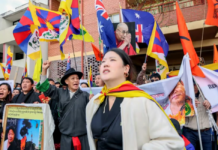
China’s Ethnic Unity Law officially came into force on July 1, prompting coordinated protests by Uyghur organisations and their allies in cities including Berlin, Brussels, London, Washington, DC, Sydney, Tokyo, Zurich, and Los Angeles.
The ‘Law on Promoting Ethnic Unity and Progress’ or the ethnic unity law as is popularly called aims to forge a “shared” national identity among ethnic groups, for example by strengthening the status of Mandarin as the official language.
But overseas campaigners have argued it will further degrade the rights of ethnic minorities, such as Uyghurs and Tibetans, that Beijing is accused of persecuting.
Critics also point to a clause stating that people can be held liable for violating the law even when outside China, saying it gives the Chinese government more justification for targeting its opponents abroad.
Rights groups and international leaders condemn legislation
Amnesty International deputy regional director Sarah Brooks said the law would require “political and ideological alignment with the Chinese Communist party” and “further institutionalise … policies of forced assimilation”.
“Chinese authorities have human rights obligations requiring them to protect minority communities and their cultures, but this law does the opposite,” Brooks said.
Amnesty has warned the legislation is pushing ethnic groups to “adopt a single, state-defined national identity dominated by Han Chinese culture”, referring to the nation’s ethnic majority.
In the United States, 14 bipartisan members of the House of Representatives urged Secretary of State Marco Rubio to publicly condemn the legislation.
Taiwan expressed “strong condemnation” of the law on Wednesday, the day the legislation came into effect, saying it expanded “threats and intimidation against the people of our country and other nations”.
“In the future, individuals from any country whose words or actions are not acceptable to China may become targets of the law or be pursued under it,” its foreign ministry said.
China claims Taiwan is part of its territory and has threatened to use force to annex the self-ruled, democratic island.